Fire Station Open House and First Responder Appreciation Event DJ Guide for Auburn, AL: Ceremony Audio, Bay Acoustics, and a 5-Step Booking Checklist
Key Takeaways
- •Fire station bay doors create a unique acoustic space that needs careful speaker placement and subwoofer management to control echo and low-end buildup.
- •Ceremony audio requires a minute-by-minute cue sheet covering flag presentation, moment of silence, recognition speeches, and the transition to family-friendly entertainment.
- •First responder events blend formality and fun, so your DJ should know how to shift from a solemn flag ceremony to kids dancing on the apron in under five minutes.
- •DJ K-TOUCH brings 15 years of community event experience across Auburn, Opelika, and Lee County, with equipment rated for concrete bay environments.
- •Call or text (334) 521-2835 to lock in your date before fire prevention week fills up.
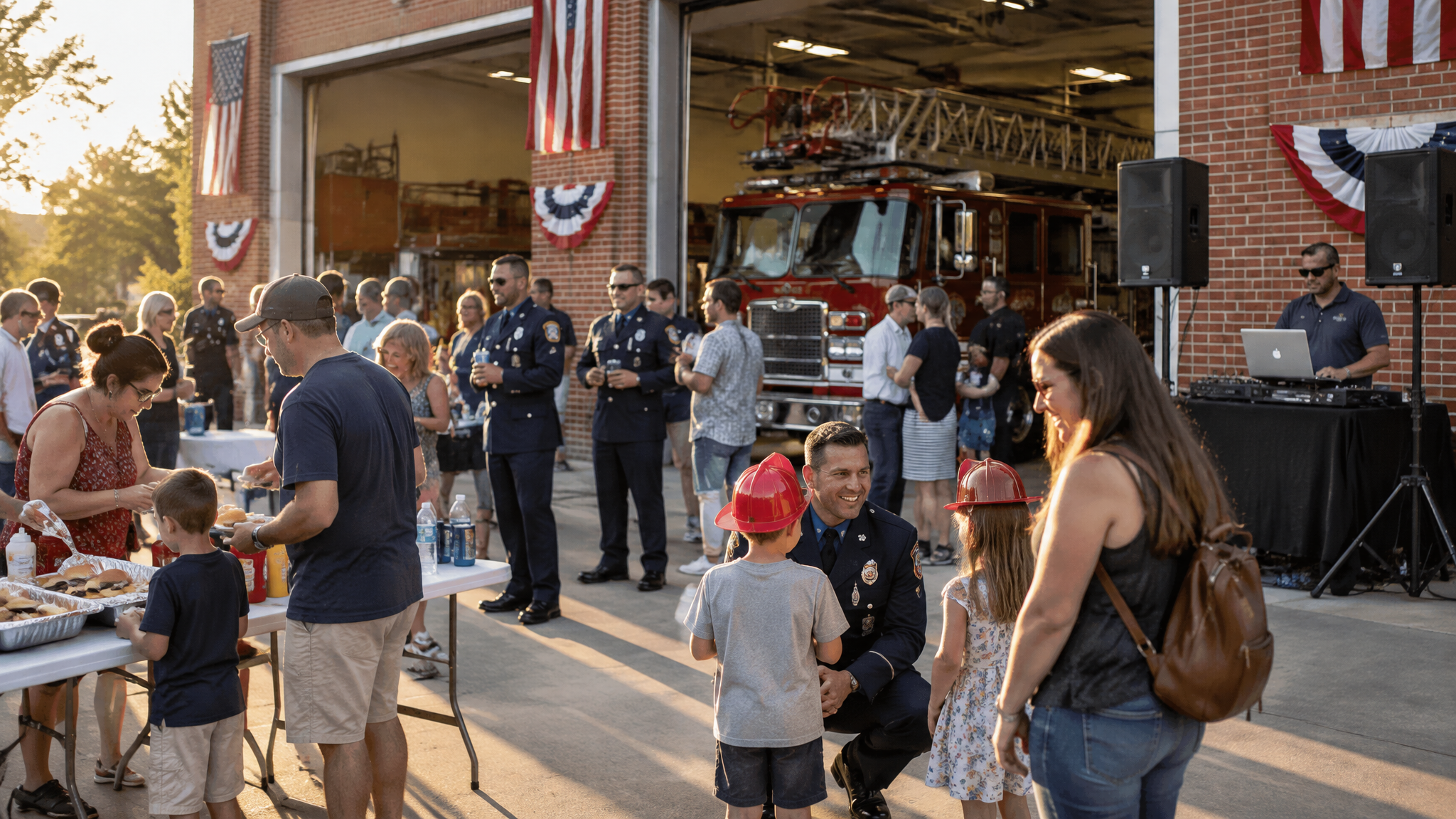
Every October, Auburn Fire Station 1 on North Gay Street throws open its bay doors for the community. Kids climb onto the ladder truck, families line up for hot dogs, and somewhere between the Dalmatian mascot photo op and a toddler spraying the practice hose, a question always comes up: "Who's running the music?" I'm Kevin Hoard, DJ K-TOUCH, and I've been the answer to that question for departments across Lee County since 2016. This guide covers everything you need to plan a fire station open house or first responder appreciation event with professional DJ entertainment, from ceremony audio cues to bay acoustics to a step-by-step booking checklist.
If you're organizing this year's event and want to skip straight to planning, call or text me at (334) 521-2835 or email [email protected].
Why First Responder Events Need a Dedicated DJ
A backyard birthday and a firefighter appreciation night might share the same folding tables, but they live in completely different worlds. One is loose from the first song. The other opens with a color guard, a chaplain's invocation, and a moment of silence for fallen brothers and sisters. Getting the transition from solemn ceremony to community block party right takes more than a Bluetooth speaker and a Spotify playlist.
I remember running audio for an Opelika Fire Department appreciation cookout a few years back. The battalion chief handed me a typed cue sheet ten minutes before the program started. Flag presentation, national anthem (live vocalist), roll call of retired members, a bell-ringing ceremony, then "hit something upbeat for the kids." That five-minute window between the last bell toll and the first kid running onto the apron to dance is the hardest transition in community events. You need someone behind the board who understands pacing and tone, not just volume.
Professional DJ services bring three things a DIY setup cannot match: reliable ceremony-grade audio that won't cut out during a speech, seamless tone shifts between formal and fun, and a backup plan when a truck gets called out mid-event and you suddenly have an engine bay's worth of empty space to fill with energy.
Fire Station Bay Acoustics: Concrete, Metal, and Echo Management
Station bays are built for durability, not acoustics. You're working with polished concrete floors, corrugated metal ceilings at 14 to 18 feet, and steel roll-up doors that act as giant reflective panels when closed or wind tunnels when open. The result is a reverb time (RT60) that can hit 2.5 seconds in a standard two-bay station, roughly triple what you want for clear speech.
Here's how I handle it.
Speaker placement: I position main PA cabinets (QSC K12.2 or EV ZLX-15BT) at the front edge of the bay opening, angled outward toward the apron and parking lot where most of the crowd gathers. This keeps the direct sound path short and reduces bounce off the back wall. For speeches, I add a single delay speaker on a tripod 40 feet back in the crowd, timed at roughly 35 milliseconds to stay in sync with the mains.
Subwoofer management: Low frequencies love concrete. An 18-inch sub sitting directly on a polished bay floor will couple with the slab and produce a boomy, muddy low end that rattles tool cages and makes chest cavities vibrate at 60 Hz. I use a high-pass filter at 50 Hz and keep the sub crossover at 90 Hz to maintain warmth without the earthquake effect.
Open-door vs. closed-door modes: When the bay doors are up, you lose about 6 dB of low-end energy to the outdoors, which actually helps clarity. When doors drop (rain, cold snap, or a truck rolling back in), that energy bounces back and your levels jump. I keep a hand on the EQ during door transitions.
| Acoustic Challenge | Closed Bay | Open Bay | DJ K-TOUCH Solution |
|---|---|---|---|
| Reverb time (RT60) | 2.0 to 2.5 sec | 1.0 to 1.4 sec | Directional PA + delay speaker |
| Low-end buildup | Severe (60 to 80 Hz peak) | Moderate | High-pass at 50 Hz, sub crossover 90 Hz |
| Speech intelligibility | Poor without treatment | Good with direct aim | Wireless lapel mic + front-loaded PA |
| Wind/traffic noise | Minimal | 65 to 75 dB ambient | +6 dB gain on mains, noise gate on mic |
Ceremony Audio Timeline: Cue-by-Cue Breakdown
The formal portion of a first responder event follows a predictable structure, but every department adds its own touches. I build a master cue sheet with the event coordinator or chief at least two weeks out, then we walk through it on-site the morning of. Here's a typical ceremony timeline I've used for Auburn and Opelika departments.
| Time | Cue | Audio Action | Notes |
|---|---|---|---|
| 0:00 | Crowd gathering | Low instrumental patriotic mix at 70 dB | "God Bless America" instrumental, "America the Beautiful" strings |
| 0:15 | Emcee welcome | Cut music, open wireless mic | I serve as emcee when requested |
| 0:17 | Color guard entrance | "The Stars and Stripes Forever" at 75 dB | Fade as colors reach the stand |
| 0:20 | National anthem | Live vocalist or recorded, full PA | Hot mic check 10 min prior |
| 0:23 | Invocation/chaplain | Wireless lapel mic, 72 dB | Monitor for feedback near bay walls |
| 0:26 | Roll call / recognition | Name announcement mic, soft underscore | "Hymn to the Fallen" instrumental beneath |
| 0:30 | Bell ceremony | Kill all music, bell audio only | Three sets of three tolls |
| 0:32 | Moment of silence | Complete silence, 10 seconds | I mute all channels |
| 0:33 | Closing remarks | Mic only | Chief or mayor speaks |
| 0:36 | Transition to community event | "Celebration" by Kool & The Gang, fade up 70 to 85 dB over 30 sec | Kids start moving immediately |
That 30-second fade from silence to celebration is the moment that defines the event. Rush it and you cheapen the ceremony. Drag it and you lose the kids. I've found that starting with a recognizable intro, letting it build naturally, and hitting the chorus right as the color guard clears the area gives everyone permission to shift gears.
Kevin books a limited number of weddings and events each month across Auburn and the surrounding area. Reach out today and let’s talk about your day.
First Responder Event vs. Military Appreciation vs. Community Cookout
Not every community event carries the same weight, and confusing them creates problems. A first responder appreciation at Station 1 demands a different energy than a Fourth of July cookout at Kiesel Park. Here's how the three compare from a DJ planning perspective.
| Factor | First Responder Appreciation | Military Appreciation | Community Cookout |
|---|---|---|---|
| Formality level | High opening, casual second half | High throughout, formal close | Casual from start |
| Expected attendance | 150 to 400 | 200 to 600 | 300 to 1,000+ |
| Ceremony length | 15 to 30 min | 30 to 60 min | None or brief welcome |
| Sound system size | Mid (2 tops + 1 sub) | Large (4 tops + 2 subs) | Mid to large |
| Avg. event duration | 3 to 4 hours | 4 to 6 hours | 2 to 4 hours |
| Key audio need | Ceremony-to-party transition | Sustained formal tone | High energy from start |
| Microphone count | 2 to 3 (emcee + presenters) | 4 to 6 (multiple speakers) | 1 to 2 |
| Music style after ceremony | Family pop, classic rock, country | Patriotic mix, country, classic rock | Current hits, line dances |
Understanding these differences matters because a coordinator who books "a DJ for our firefighter event" might be picturing anything from a formal awards banquet to a slip-and-slide on the station lawn. I always ask three questions in the first phone call: Is there a ceremony component? Will active-duty personnel be in dress uniform? Are children a primary audience? Those answers shape every decision from speaker count to playlist.
Family-Friendly Playlist Strategy for Mixed-Age Crowds
Fire station events pull everyone from six-month-old babies in strollers to 80-year-old retired chiefs. The playlist has to work across four generations without alienating anyone or crossing content lines.
I build three playlist zones that rotate throughout the community portion of the event.
Zone 1, Kids and families (first 45 minutes after ceremony): "Happy" by Pharrell, "Can't Stop the Feeling" by Justin Timberlake, "Shake It Off" by Taylor Swift, the Cha Cha Slide, the Cupid Shuffle. High energy, universally known, zero content risk.
Zone 2, Classic and country (middle hour): "Sweet Home Alabama" by Lynyrd Skynyrd (always a crowd favorite in Auburn), "Friends in Low Places" by Garth Brooks, "Brown Eyed Girl" by Van Morrison, "Signed, Sealed, Delivered" by Stevie Wonder. This is when parents grab plates and kids hit the bounce house.
Zone 3, Modern mix (final hour): Current clean radio hits, line dance requests, and a few throwbacks to keep the older crowd engaged. I use a three-layer content filter: streaming service explicit tag, personal lyric review, and event coordinator approval for any borderline tracks.
Every song goes through that filter before it hits the playlist. Fire departments are public-facing organizations. One inappropriate lyric on a loudspeaker and you've got a news story nobody wants. I keep a pre-screened list of 200+ songs specifically tagged for first responder and community events. For school-related content filtering details, check out our school events guide.
Noise Management and Neighborhood Compliance
Most fire stations sit in residential neighborhoods or mixed-use zones. Auburn's noise ordinance (City Code Chapter 30) restricts amplified sound above 85 dB at the property line after 10 PM on weekdays and 11 PM on weekends. Opelika's rules are similar but measured at 50 feet from the source.
I bring a calibrated SPL meter (NIOSH-compliant) to every station event and take baseline readings before the first note plays. Here's my compliance protocol.
Pre-event: Walk the perimeter with the event coordinator and identify the nearest residential windows. Measure ambient noise (usually 55 to 65 dB near a station due to traffic). Set a target max of 80 dB at the property line, leaving a 5 dB cushion below the legal limit.
During event: I position the SPL meter at the property line on a tripod and check readings every 30 minutes. If we're trending above 78 dB, I pull the mains down 2 dB and adjust the sub.
Truck departures: When a truck gets called out during the event, the siren and engine noise will spike to 110+ dB. I kill my system entirely during the departure, let the truck clear the apron, then bring music back at 50% and ramp up over 15 seconds. Trying to compete with a siren is pointless and dangerous for hearing.
| Compliance Factor | Auburn Rule | Opelika Rule | DJ K-TOUCH Protocol |
|---|---|---|---|
| Max dB at property line | 85 dB after 10 PM | 85 dB at 50 ft | Target 80 dB (5 dB cushion) |
| Measurement standard | Property line | 50 ft from source | NIOSH-calibrated SPL meter |
| Permit required | No (city-sponsored events exempt) | No (department events exempt) | Confirm exemption with chief |
| Truck departure protocol | N/A | N/A | Kill audio, 15-sec ramp back |
Special Considerations: Dalmatian Mascots, Ladder Truck Tours, and Kids on the Hose
The fun stuff at a fire station open house creates unique DJ moments that you won't find at any other event type.
Dalmatian mascot walk-up: If the department has a mascot (or a real Dalmatian, which Auburn's Station 1 occasionally brings), I play "Who Let the Dogs Out" as the walk-up song. Predictable? Yes. Effective? Every single time. The kids lose their minds.
Ladder truck horn demo: Departments love showing off the air horn. I coordinate with the engineer to time it between songs, never during a speech or quiet moment. I also warn parents through the mic 30 seconds before so nobody's toddler has a meltdown.
Practice hose station: When kids line up to spray the practice hose, I switch to high-energy tracks and do play-by-play commentary on the mic. "We've got a future firefighter on hose two, folks!" This keeps the crowd engaged during what could otherwise be dead time.
Gear try-on station: Slower background music while kids try on helmets and turnout coats. I lower volume to conversation level (65 to 70 dB) so parents can take photos and talk to firefighters without shouting.
For events that include photo opportunities, our photo booth services add a shareable keepsake with custom fire department overlays and printed strips.
Equipment Checklist for Station Events
Running a station event requires gear that can handle outdoor conditions, concrete acoustics, and fast setup in a working emergency facility. Here's what I bring.
Two QSC K12.2 powered tops on tripod stands. One QSC KS118 subwoofer with high-pass at 50 Hz. One delay speaker (EV ZLX-12BT) on tripod for deep crowd coverage. Two wireless handheld microphones (Shure BLX288/PG58) for emcee and guest speakers. One wireless lapel mic (Shure BLX14/CVL) for clergy or chief during ceremony. 200 feet of heavy-gauge extension cords (stations have limited outdoor outlets). Calibrated SPL meter on tripod. Backup Bluetooth speaker (JBL Eon One Compact) in case of main system failure.
Setup time: 90 minutes before event. Teardown: 60 minutes. I always confirm with the battalion chief that the bay I'm setting up in won't be needed for a truck call, and I keep all cable runs taped flat with gaffer tape so nobody trips during an emergency response.
5-Step Booking Checklist for Your Fire Station Event
Step 1: Contact DJ K-TOUCH. Call or text (334) 521-2835 or email [email protected]. I'll ask about ceremony structure, expected attendance, and whether the event is indoors (bay) or on the apron/parking lot.
Step 2: Schedule a site walk. I visit the station to assess bay dimensions, outlet locations, nearest residential property lines, and door operation. This visit takes about 30 minutes.
Step 3: Build the cue sheet. We create a ceremony timeline together, including every mic handoff, music cue, and moment of silence. I'll send a draft for the chief's approval.
Step 4: Confirm logistics. Power source (I bring my own distribution board if needed), load-in time (minimum 90 minutes), parking for my vehicle near the setup area, and a rain plan (close bay doors and move crowd inside).
Step 5: Lock in your date. Fire prevention week (early October) books fast across Lee County. I recommend booking at least six weeks out for October events and four weeks for other months. Visit our contact page to send a booking inquiry.
Kevin books a limited number of weddings and events each month across Auburn and the surrounding area. Reach out today and let’s talk about your day.
Ready to make your fire station open house or first responder appreciation event the best one yet? I've been doing this across Auburn, Opelika, and Lee County for over 15 years, and I bring the same care to a station cookout that I bring to a 300-guest wedding. Call or text (334) 521-2835 or email [email protected] today, and let's build your event together.
Frequently Asked Questions
How much does a DJ cost for a fire station open house in Auburn?
Every event is different. Call (334) 521-2835 for a custom quote based on your ceremony length, crowd size, and equipment needs. I never use cookie-cutter pricing.
Can you serve as emcee for the ceremony portion?
Yes. I regularly emcee flag ceremonies, recognition programs, and community introductions. I'll work from your cue sheet or build one with your chief.
What happens if a truck gets called out during the event?
I kill all audio immediately, let the truck clear, then bring music back at half volume and ramp up over 15 seconds. Safety always comes first.
Do you have experience with military appreciation events too?
Yes. Military events run longer ceremonies with more formal protocols. I adjust speaker count, mic allocation, and playlist tone accordingly.
How far in advance should we book for fire prevention week?
At least six weeks. October is the busiest month for station events across Lee County. Four weeks is enough for other months.
Can you handle outdoor events on the station apron?
Absolutely. I bring weather-rated gear and monitor wind noise. If rain hits, we move inside the bay and I adjust EQ for the enclosed space.
Do you provide photo booth services for fire station events?
Yes. We offer custom fire department overlays, printed strips, and digital sharing through our photo booth packages. Great for community engagement.
About the Author
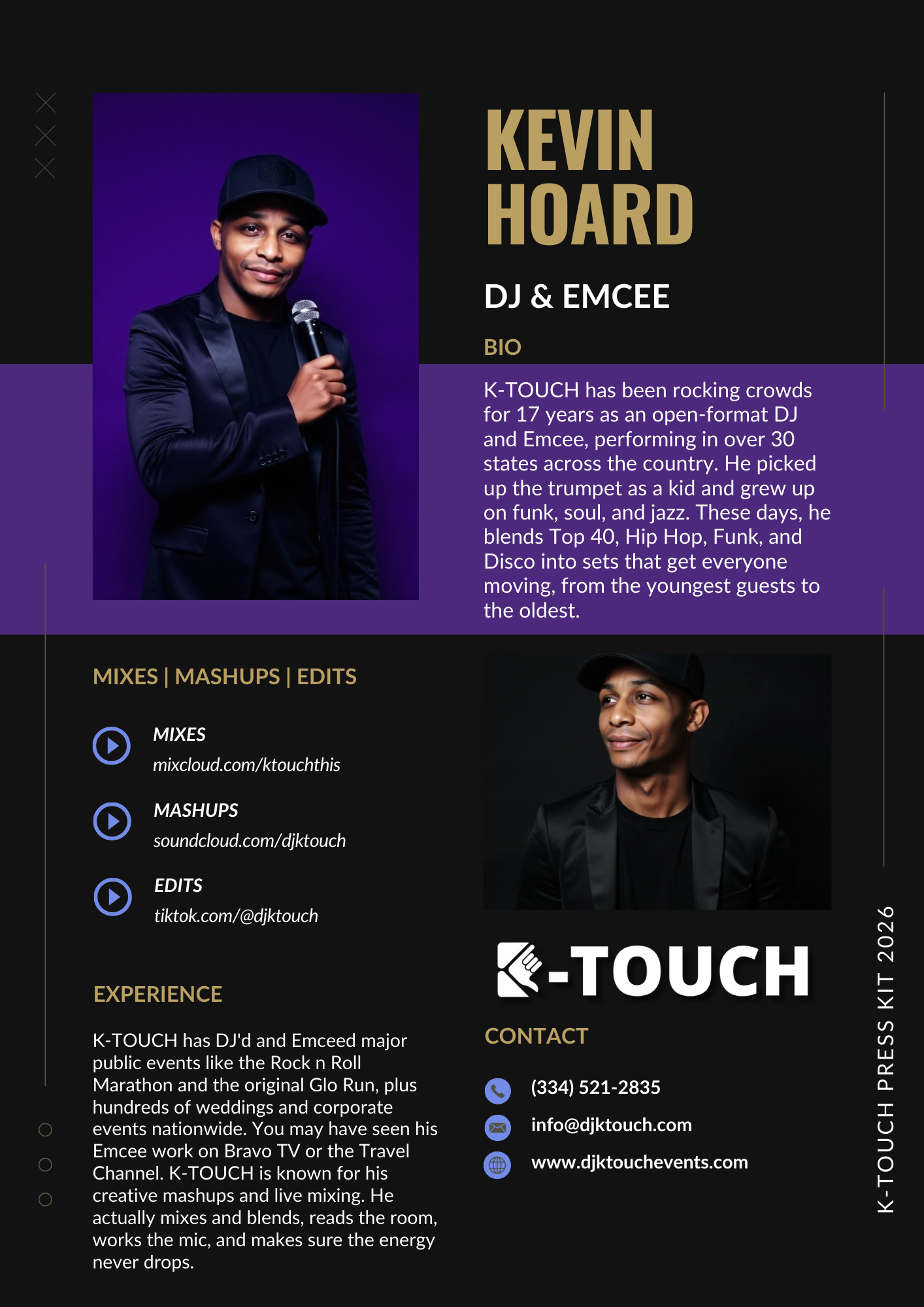
Kevin Hoard (DJ K-TOUCH)
Kevin is the lead DJ and MC behind DJ K-TOUCH Events & Services. He has been DJing Auburn area weddings since 2012 and started DKES in 2019. He has read hundreds of dance floors across Auburn, Opelika, Montgomery, and beyond, and he writes these guides to help couples plan events that actually feel like them.
Let’s Talk About Your Event
Whether it’s a wedding, a school dance, or a company party, Kevin will help you build a night your guests remember. Dates around Auburn book up fast, so reach out early.