Neighborhood 5K and Fun Run DJ Guide for Auburn, AL: Course Audio Zones, Finish Line Energy, and a 5-Step Booking Checklist
Key Takeaways
- •Strategic audio zone placement along the course keeps runners motivated without blasting nearby homes.
- •Start line hype and finish line celebrations require completely different sound setups and energy arcs.
- •A 5K vs fun run vs color run comparison helps you pick the right DJ package for your event size.
- •Battery-powered speakers solve the biggest challenge of powering sound on residential streets.
- •Booking 8 to 10 weeks out locks in permits, route coordination, and your preferred DJ date.
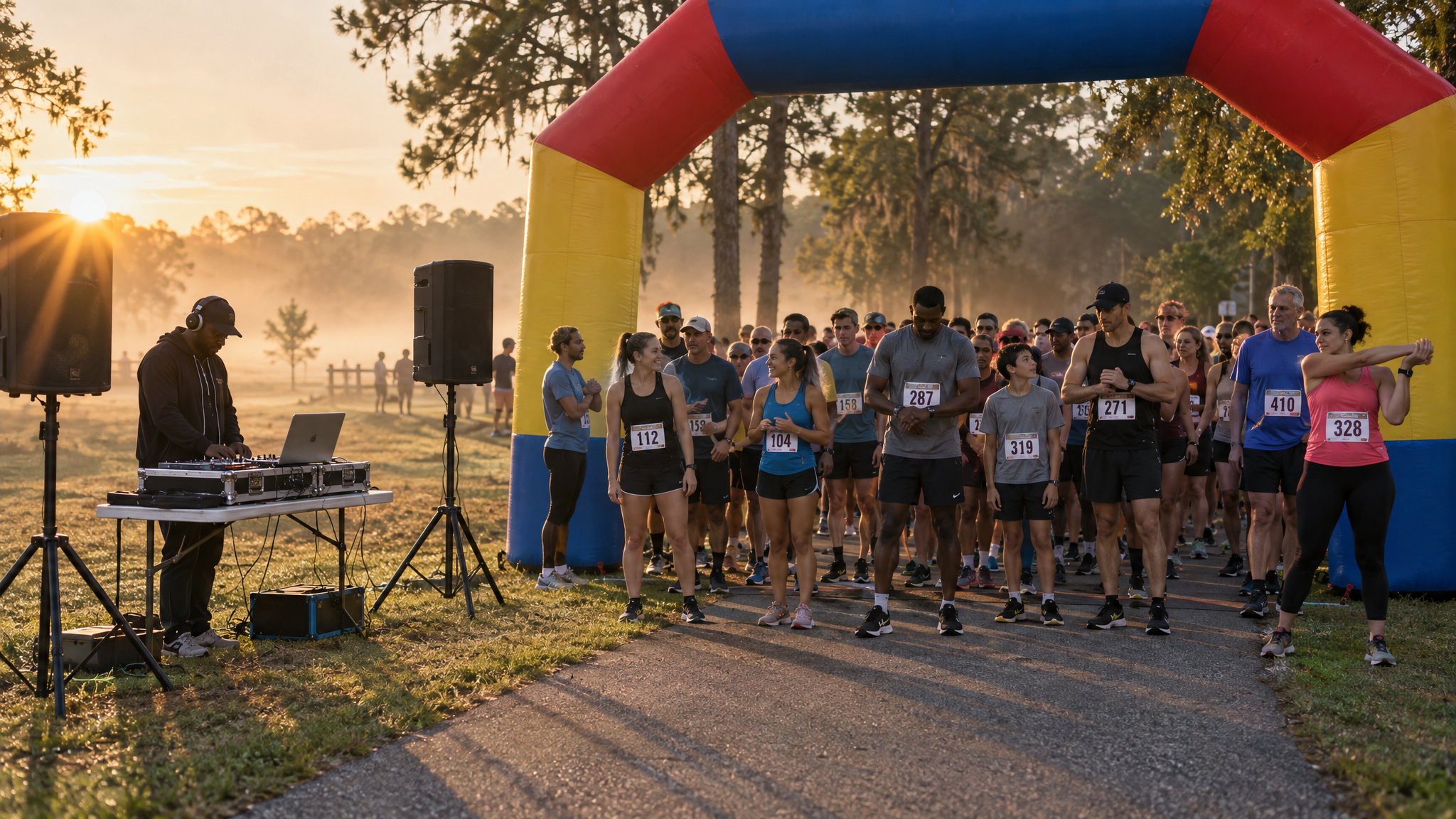
The fog sat low over Kiesel Park last April when I rolled my equipment cart down the paved trail at 5:45 a.m. Volunteers in neon vests were already taping mile markers to fence posts, and the inflatable arch at the starting line hummed with the blower fan underneath it. By the time the first 300 runners lined up behind the timing mat, I had three audio zones live across a 3.1-mile course, and every single one served a different purpose. That morning taught me something I now build into every race: a 5K is not one event. It is three events stitched together by a trail, and each segment needs its own sound strategy.
If you are organizing a neighborhood 5K, color run, or fun run anywhere in the Auburn, Opelika, or Lee County area, this guide walks you through exactly how I set up course audio zones, build start line energy, and turn the finish line into a celebration your community talks about for months. Have questions before we get rolling? Call or text me at (334) 521-2835 or email [email protected].
5K vs Fun Run vs Color Run: Picking the Right Format
Before we talk speakers and song lists, you need to know which format fits your community. I have DJed all three in the Auburn area, and the production needs are surprisingly different.
| Feature | Traditional 5K | Fun Run | Color Run |
|---|---|---|---|
| Participant count | 200 to 800 | 100 to 400 | 150 to 600 |
| Competitive timing | Yes, chip-timed | Usually no | No |
| Course formality | Certified, marked | Casual loop | Casual with color stations |
| Sound zones needed | 3 to 4 | 2 to 3 | 3 to 5 (one per color station) |
| Average event duration | 2 to 3 hours | 1.5 to 2.5 hours | 2 to 3.5 hours |
| Volume sensitivity | Moderate (residential routes) | Lower (park loops) | Lower (open fields) |
| DJ energy style | Motivational, pacing-focused | Party, family-friendly | High-energy, festival |
| Permit complexity | High (road closures) | Low to moderate | Moderate |
A traditional 5K on Auburn city streets means road closure permits, coordination with Auburn Public Safety, and careful volume management so you are not rattling windows on North Gay Street at 7 a.m. A fun run looping through Kiesel Park or Chewacla State Park stays mostly on trails, which gives you more acoustic freedom but less access to power. A color run adds complexity because each color station doubles as a mini sound zone. I will show you how to handle all three.
Course Audio Zone Planning: Start, Mid-Course, and Finish
This is where most race organizers make their first mistake. They rent one speaker, park it at the finish line, and hope for the best. Runners in the middle of the course hear nothing for 20 minutes, their energy drops, and walkers start bunching up at mile 2. I break every 5K into three distinct audio zones.
| Audio Zone | Location | Equipment | Purpose | Volume (dB at 10 ft) |
|---|---|---|---|---|
| Zone 1: Start Line | Behind timing mat, flanking inflatable arch | 2x QSC K12.2 on tripods, wireless mic | Countdown, announcements, warm-up mix | 92 to 95 dB |
| Zone 2: Mid-Course | Mile 1.5 marker or turnaround point | 1x JBL EON One Pro (battery) | Motivational music, pacer energy boost | 82 to 85 dB |
| Zone 3: Finish Line | 50 feet past timing mat, facing incoming runners | 2x QSC K12.2, subwoofer, wireless mic | Celebration, name call-outs, awards | 95 to 98 dB |
Zone 2 is the secret weapon. When runners hit the halfway mark and their legs start complaining, hearing "Lose Yourself" by Eminem or "Stronger" by Kanye West punching through the trees does something physiological. Heart rates stabilize, cadence picks up, and the walkers who were about to quit push through to the downhill. I run Zone 2 entirely on battery power, which means zero generators and zero extension cords crossing the trail.
For color runs, I add a Zone 2A and Zone 2B at the second and fourth color stations. Each gets a single battery-powered Bose S1 Pro+ running a pre-programmed playlist timed to the average pace group. The color throw volunteers love it because it gives them a rhythm to work with.
Battery-Powered Speaker Comparison for Course Setups
Power is the biggest logistical headache for any race DJ. Residential streets and park trails do not have outlets every quarter mile. Here is what I carry and how the runtime breaks down.
| Speaker Model | Battery Runtime (pointed volume) | Weight | Max SPL | Best Use Case |
|---|---|---|---|---|
| JBL EON One Pro | 6 hours at 80 dB | 33 lbs | 118 dB peak | Mid-course solo zone |
| Bose S1 Pro+ | 11 hours at 75 dB | 15.5 lbs | 109 dB peak | Color stations, aid stations |
| JBL PartyBox 310 | 18 hours at moderate | 36.5 lbs | Not rated (party use) | Post-race party area |
| QSC K12.2 (with generator) | Unlimited (AC powered) | 40 lbs | 132 dB peak | Start and finish lines |
The Bose S1 Pro+ is my go-to for color stations because a volunteer can carry it in one hand, it lasts an entire race without charging, and the 109 dB peak is enough to cut through crowd noise within a 40-foot radius. For the mid-course motivational zone, the JBL EON One Pro delivers fuller bass response, which matters when you are trying to push energy into tired legs.
Kevin books a limited number of weddings and events each month across Auburn and the surrounding area. Reach out today and let’s talk about your day.
Start Line Hype: The 15-Minute Countdown Protocol
The start line is where your race lives or dies in runners' memories. I have watched events where the organizer grabbed a bullhorn, mumbled "ready set go," and 300 confused people shuffled forward. Here is what I do instead.
I arrive 90 minutes before the gun and set up Zone 1 behind the timing mat. The warm-up mix starts 30 minutes before race time at 85 dB, just enough to build atmosphere without overwhelming registration conversations. At T-minus 15 minutes, I shift into the countdown protocol.
T-minus 15:00 to T-minus 10:00: Mid-tempo warm-up. "Good as Hell" by Lizzo, "Walking on Sunshine" by Katrina and the Waves. I call out sponsors, thank the organizing committee by name, and remind runners about the course layout.
T-minus 10:00 to T-minus 5:00: Energy ramp. "Can't Hold Us" by Macklemore, "Blinding Lights" by The Weeknd. I bring the race director to the mic for final instructions. Volume nudges up to 90 dB.
T-minus 5:00 to T-minus 1:00: Peak hype. "Gonna Fly Now" (Rocky theme), "Thunderstruck" by AC/DC. Runners are bouncing. I lead a group stretch call if the organizer wants one.
T-minus 0:30: I drop the music to a low pulse, grab the mic, and do the countdown. "Thirty seconds!" The crowd roars. "Ten, nine, eight..." At "GO" I slam "Run This Town" by Jay-Z and the horn blasts from the timing system sync perfectly because I have rehearsed the cue with the race director twice.
That 15-minute arc took me three races to perfect. The first time I tried it at a Toomer's Corner fun run, I started the hype too early and runners were fatigued before they even crossed the mat. Pacing the energy like a wedding reception dance set, with a slow build and a sharp peak, changed everything.
Finish Line Celebration: Name Call-Outs and Awards
The finish line is where community 5Ks separate themselves from generic races. I position Zone 3 about 50 feet past the timing mat, facing incoming runners so they hear the music growing louder as they approach. The sub sits behind the arch pointed down the final straightaway.
Here is what makes the finish line special: name call-outs. I work with the registration team to get the participant list sorted by bib number. As each runner crosses the mat, a volunteer radios me the bib number, and I announce their name and hometown. "Number 247, Sarah Mitchell from Opelika, great finish!" When you hear your name booming across the park after 30 minutes of hard running, that is the moment you sign up again next year.
For the awards ceremony, I switch to a more structured MC mode. I have a ceremony playlist cued up: "We Are the Champions" by Queen for overall winners, "Celebration" by Kool and the Gang for age group awards. The whole awards segment runs 20 to 30 minutes, and I keep the energy conversational so families with kids stay engaged instead of wandering to the parking lot.
Road Closure Permits and Noise Compliance for Auburn and Opelika
If your 5K uses public roads, you need permits, and the sound component adds a layer most organizers forget about. Here is a breakdown of what I have navigated in both cities.
| Requirement | Auburn | Opelika |
|---|---|---|
| Road closure application | Auburn Public Safety, 30 days prior | Opelika Police Department, 30 days prior |
| Amplified sound permit | Required if sound exceeds 85 dB at property line | Required for events over 100 attendees |
| Noise ordinance quiet hours | Before 7 a.m. and after 10 p.m. | Before 7 a.m. and after 11 p.m. |
| Residential buffer zone | 100 feet from occupied residences recommended | 75 feet from residential structures |
| Insurance requirement | $1M general liability naming City of Auburn | $1M general liability naming City of Opelika |
| Application fee | Varies by route complexity | Flat fee, contact OPD for current rate |
| Typical approval timeline | 2 to 3 weeks | 2 to 3 weeks |
The 7 a.m. quiet hour cutoff matters because most 5Ks want an 8 a.m. start, which means I can fire up the warm-up mix no earlier than 7:00. For races that start at 7:30 a.m., I keep Zone 1 at 80 dB until 7:00, then ramp up. I have never had a noise complaint using this approach, even on the residential stretch of East Thach Avenue near campus.
One detail most organizers miss: the amplified sound permit is separate from the road closure permit. You need both. I always remind my clients to file them together because approval timelines overlap.
Course Audio Timeline: Song Selections by Runner Pace Group
Different pace groups hit each audio zone at different times. A 7-minute-mile runner reaches the mid-course zone 10 minutes after the start. A 12-minute-mile walker reaches it 18 minutes later. I program Zone 2 to run a full 45-minute set that covers both groups.
| Time After Start | Zone 2 Song | BPM | Energy Level | Target Pace Group |
|---|---|---|---|---|
| 0:00 to 8:00 | "Lose Yourself" by Eminem | 171 | High | 6:00 to 7:00 min/mile (front runners) |
| 8:00 to 14:00 | "Stronger" by Kanye West | 104 | Moderate-high | 7:00 to 9:00 min/mile |
| 14:00 to 20:00 | "Eye of the Tiger" by Survivor | 109 | Moderate-high | 9:00 to 10:00 min/mile |
| 20:00 to 28:00 | "Don't Stop Me Now" by Queen | 156 | High | 10:00 to 12:00 min/mile |
| 28:00 to 36:00 | "Shut Up and Dance" by Walk the Moon | 128 | Moderate-high | 12:00 to 14:00 min/mile (walkers) |
| 36:00 to 45:00 | "Happy" by Pharrell Williams | 160 | Feel-good, encouraging | Tail walkers and volunteers |
I match BPM to the expected energy state of each pace group. Front runners are already in a groove, so they get the highest intensity track right away. The mid-pack gets anthems they know and can sing along to, which distracts from the discomfort. Tail walkers get feel-good music that says "you are almost there" without being patronizing.
Kevin books a limited number of weddings and events each month across Auburn and the surrounding area. Reach out today and let’s talk about your day.
5-Step Booking Checklist for Your Auburn 5K or Fun Run
Here is exactly how to lock in DJ services for your race.
Step 1: Contact DJ K-TOUCH 8 to 10 weeks before race day. Call or text (334) 521-2835 or email [email protected]. Tell me your race format (5K, fun run, color run), estimated participant count, and course location.
Step 2: Share your course map and mile marker locations. I will identify optimal audio zone placements and check power availability at each point. If we need battery-powered setups for mid-course, I will confirm equipment.
Step 3: Confirm permits and noise compliance. I will walk you through Auburn or Opelika requirements and remind you to file the amplified sound permit alongside your road closure application. I can join your pre-race meeting with public safety if needed.
Step 4: Send your participant registration list 48 hours before race day. I need bib numbers and names for finish line call-outs. If your registration platform exports a CSV, that works perfectly.
Step 5: Finalize your race-day timeline. We will confirm warm-up start time, countdown protocol, awards ceremony structure, and post-race celebration duration. I arrive 90 minutes before the first sound cue.
Ready to make your next 5K or fun run the one your neighborhood remembers? Call or text me at (334) 521-2835, email [email protected], or visit our services page to explore everything DJ K-TOUCH brings to community events. You can also check out our event planning resources for the full coordination picture, or browse our blog for more event guides tailored to the Auburn and Opelika community.
Frequently Asked Questions
How much does a 5K DJ cost in Auburn, AL?
Pricing depends on course length, number of audio zones, and event duration. Call (334) 521-2835 for a custom quote based on your race format and participant count.
Can you DJ a fun run on park trails without power outlets?
Yes. I carry battery-powered speakers rated for 6 to 11 hours of runtime that deliver clear, motivational sound at mid-course zones without generators or extension cords.
Do I need a sound permit for a 5K in Auburn?
If your event uses amplified sound that exceeds 85 dB at the property line, Auburn requires a separate amplified sound permit. File it with your road closure application 30 days before race day.
What songs work best for a 5K starting line?
High-energy anthems between 128 and 170 BPM. I typically cue Thunderstruck by AC/DC, Can't Hold Us by Macklemore, and the Rocky theme for the final countdown.
How do you handle finish line name announcements?
I get the participant list sorted by bib number before race day. A volunteer at the timing mat radios each bib number to me, and I announce the runner's name and hometown live.
Can you set up sound for a color run with multiple color stations?
Absolutely. I place battery-powered Bose S1 Pro+ speakers at each color station with pre-programmed playlists. Each station becomes its own mini audio zone timed to average pace groups.
How early should I book a DJ for a neighborhood 5K?
Eight to ten weeks out is ideal. That gives us time to coordinate course audio zones, confirm permits, and rehearse the start line countdown with your race director.
About the Author
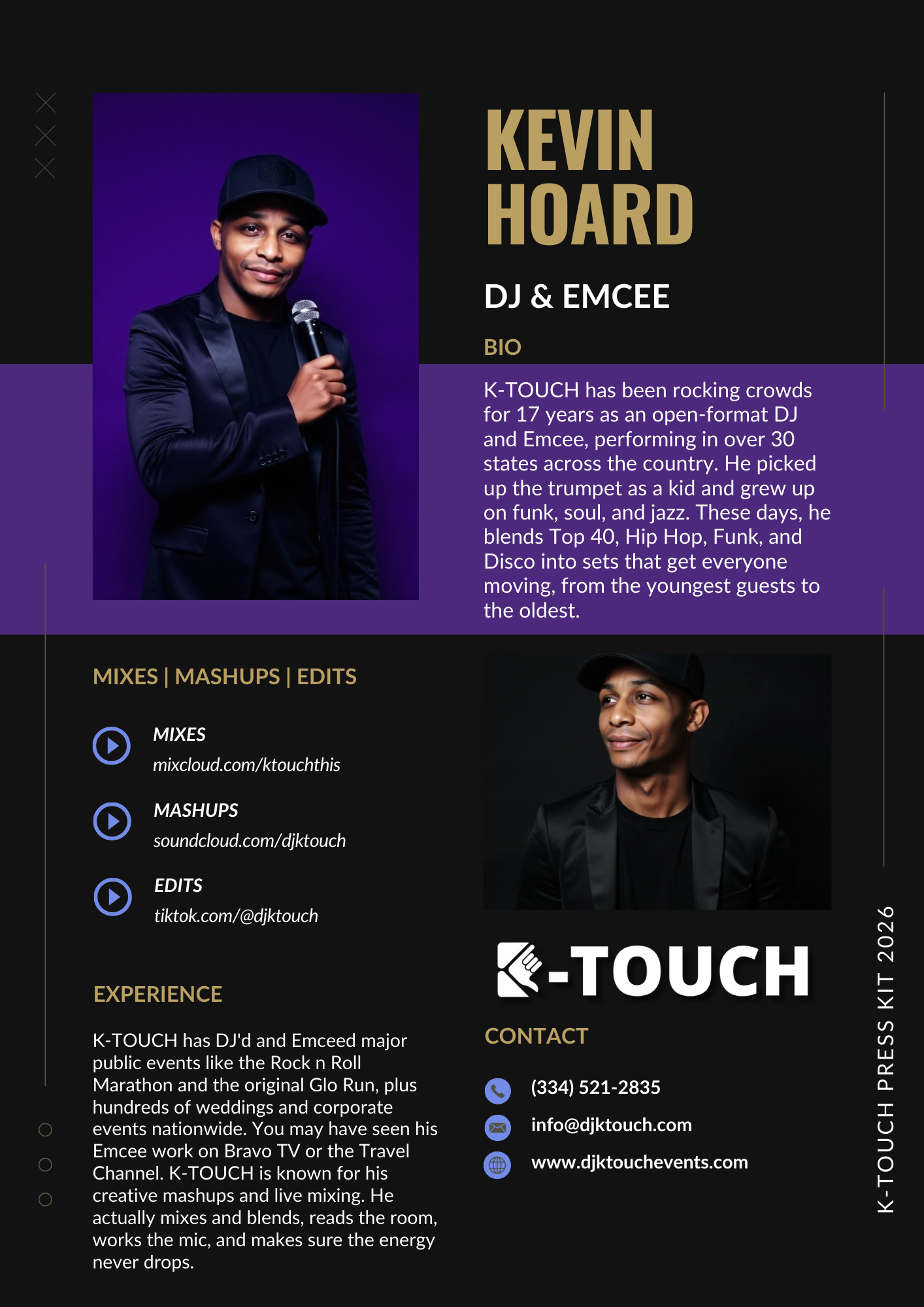
Kevin Hoard (DJ K-TOUCH)
Kevin is the lead DJ and MC behind DJ K-TOUCH Events & Services. He has been DJing Auburn area weddings since 2012 and started DKES in 2019. He has read hundreds of dance floors across Auburn, Opelika, Montgomery, and beyond, and he writes these guides to help couples plan events that actually feel like them.
Let’s Talk About Your Event
Whether it’s a wedding, a school dance, or a company party, Kevin will help you build a night your guests remember. Dates around Auburn book up fast, so reach out early.