Farmers Market and Craft Fair DJ Guide for Auburn, AL: Battery-Powered Sound, Vendor Spotlight Rotations, and a 5-Step Booking Checklist
Key Takeaways
- •Battery-powered speakers rated 108 dB or higher give you 6 hours of clean sound without a generator or extension cord at any outdoor market.
- •A vendor spotlight rotation every 30 minutes drives foot traffic to each booth and keeps sellers engaged all morning.
- •Farmers markets and craft fairs each demand different volume ceilings, playlist styles, and mic protocols, so plan your setup around the event type.
- •A weather contingency plan with a covered fallback zone and waterproof gear cases keeps the music going when Alabama storms roll in.
- •Booking 6 to 8 weeks out locks in your preferred date and gives the market manager time to coordinate power and layout.
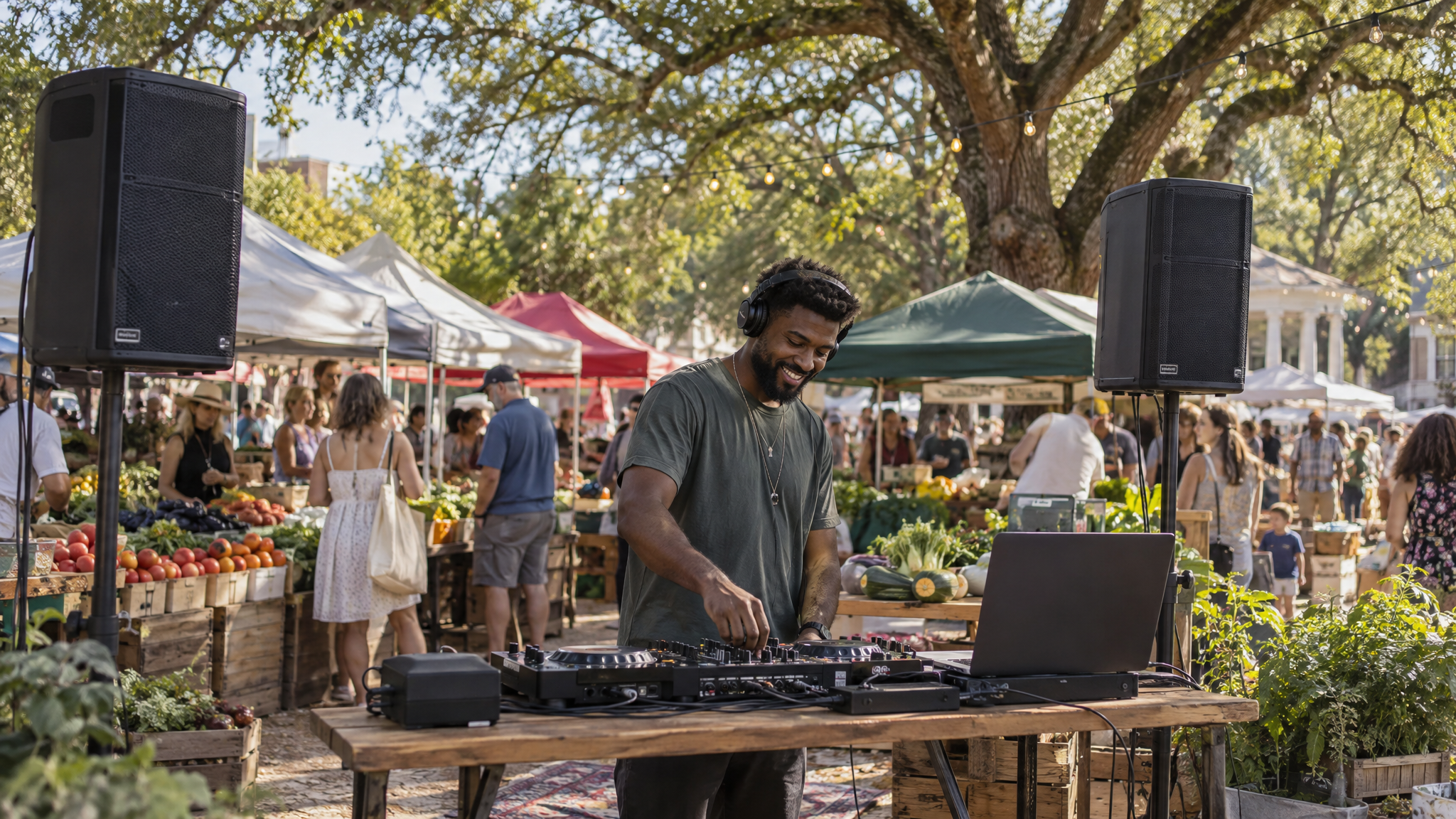
I still remember the first time I set up at the Opelika Farmers Market on a sticky Saturday morning in June. The peach vendor two stalls down had crates stacked five high, the kettle corn guy was already popping his first batch, and a line of regulars with reusable bags was forming before I even powered on my controller. By 8:15, I had Otis Redding's "Sittin' On The Dock of the Bay" floating across the pavilion at a conversational 72 dB, and the market manager told me later that vendor sales jumped about 20 percent that morning compared to their silent weekends. That is the quiet power of a well-planned farmers market DJ setup.
If you manage a farmers market, run a craft fair, or organize a seasonal flea market anywhere in Auburn, Opelika, or Lee County, this guide walks you through every detail I have learned across dozens of outdoor market gigs: battery-powered speaker math, vendor spotlight protocols, playlist strategy, weather backup plans, and a booking checklist that keeps nothing to chance. Have a question before we dig in? Text or call me at (334) 521-2835 or email [email protected].
Why a Farmers Market or Craft Fair Needs a DJ
Most market managers assume a Bluetooth speaker on a folding table is "good enough." It is not, and here is why. A single consumer speaker tops out around 85 dB, which means the second row of vendors can barely hear it over crowd chatter and the generator humming behind the food truck. A professional DJ brings three things a Bluetooth puck cannot: controlled, even sound coverage across the entire market footprint; a live mic for vendor shout-outs, raffle drawings, and safety announcements; and a curated playlist that matches the morning energy arc from casual browsing to peak foot traffic to wind-down.
I have worked the Auburn City Market, the Opelika Saturday Market near Railroad Avenue, and several pop-up craft fairs at Kiesel Park. Every single one saw measurably higher dwell time when live-mixed music replaced a static playlist. Shoppers linger, and lingering shoppers spend more.
Farmers Market vs. Craft Fair vs. Flea Market: Choosing the Right Sound Approach
Not all outdoor markets are the same. The table below breaks down the key differences that change how I plan the audio.
| Factor | Farmers Market | Craft Fair | Flea Market |
|---|---|---|---|
| Typical hours | 7 AM to noon | 10 AM to 5 PM | 8 AM to 3 PM |
| Average vendor count | 20 to 40 | 30 to 60 | 50 to 100+ |
| Volume ceiling (dB at 30 ft) | 70 to 75 | 75 to 80 | 78 to 85 |
| Playlist style | Acoustic, soul, light jazz | Indie pop, folk, upbeat acoustic | Classic rock, country, pop mix |
| Mic usage | Vendor spotlights, announcements | Artist demos, raffle calls | Minimal, price announcements only |
| Power source | Usually battery or market outlet | Venue-provided 20A circuit | Generator or battery |
For Auburn-area farmers markets, I keep volume between 70 and 75 dB measured at 30 feet from the speaker stack. That is loud enough to create atmosphere but quiet enough for a customer to ask "how much for the tomatoes?" without shouting. Craft fairs run a touch louder because the browsing energy is different and vendor booths tend to be spaced farther apart.
Battery-Powered Speaker Setup and Runtime Calculations
Power is the number one logistical question at outdoor markets. Most farmers markets do not have convenient 20-amp circuits scattered around the pavilion, and running extension cords across foot traffic paths is a liability the market manager does not want. That is why I run battery-powered rigs for 90 percent of my market gigs.
Here is the gear math I use for a typical 25-vendor Auburn farmers market covering about 8,000 square feet of open-air space.
| Component | Model Example | Battery Runtime | Weight | Output |
|---|---|---|---|---|
| Main PA (x2) | JBL EON One Compact | 12 hours at 50% volume | 17.6 lbs each | 112 dB peak |
| Subwoofer (optional) | Bose S1 Pro+ | 11 hours | 15.4 lbs | 108 dB peak |
| Wireless mic | Shure BLX288/PG58 | 14 hours (AA batteries) | Handheld | N/A |
| Controller + laptop | Pioneer DDJ-FLX4 | Laptop battery 6 to 8 hours | 4.2 lbs | N/A |
Two JBL EON One Compacts on tripod stands spaced 40 feet apart give me even 72 to 75 dB coverage across the full market footprint without a single extension cord. I carry two fully charged backup batteries that snap in if a unit drops below 15 percent, but in three years of market gigs I have never needed them before hour ten.
The key number to remember: at 50 percent volume, most pro battery speakers deliver 10 to 12 hours of continuous playback. A six-hour farmers market leaves a comfortable four-hour buffer. If the market runs longer than eight hours (rare in Auburn, but it happens for holiday markets), I swap in a fresh battery at the halfway mark and keep rolling.
Kevin books a limited number of weddings and events each month across Auburn and the surrounding area. Reach out today and let’s talk about your day.
Vendor Spotlight Rotation Protocol
This is the section that gets market managers excited when I walk them through my process. A vendor spotlight rotation means I announce a featured vendor over the mic every 25 to 30 minutes, name their booth location, describe one specific product, and play a short "walk-up" song that draws foot traffic in that direction.
Here is how the rotation works at a 30-vendor market running from 8 AM to noon:
- Pre-event coordination. I collect vendor names, booth numbers, and one sentence about their top product the week before. I build the rotation schedule so every vendor gets at least one spotlight during the market window.
- Opening announcement (8:00 AM). Welcome, market hours, restroom location, special events. I play Bill Withers' "Lovely Day" as the opening walk-in track.
- First spotlight (8:25 AM). "Head over to booth seven, where Davis Family Farms has the first Chilton County peaches of the season. Grab a basket before they are gone." I drop in Van Morrison's "Brown Eyed Girl" as a bright transition.
- Rotate every 25 to 30 minutes. Each spotlight is 15 to 20 seconds max. I keep it conversational, never salesy.
- Closing spotlight (11:45 AM). Final vendor feature, then a "thank you for shopping local" sign-off with Sam Cooke's "Having a Party" as the last track.
Market managers at the Opelika Saturday Market told me vendor satisfaction scores went up after we started the rotation because every seller felt included, not just the ones near the entrance. For more on how I handle vendor coordination at large events, check out our event planning services.
Playlist Strategy: Matching the Morning Energy Arc
A farmers market is not a club. The energy arc is completely different, and your playlist has to follow it. Here is the tempo and genre map I use for a standard 7 AM to noon Auburn market:
| Time Block | BPM Range | Genre Focus | Example Tracks |
|---|---|---|---|
| 7:00 to 8:00 AM (setup, early birds) | 70 to 85 | Acoustic covers, light jazz | Jack Johnson "Better Together," Norah Jones "Sunrise" |
| 8:00 to 9:30 AM (building crowd) | 85 to 100 | Soul, folk, soft pop | Al Green "Let's Stay Together," The Lumineers "Ho Hey" |
| 9:30 to 11:00 AM (peak traffic) | 100 to 115 | Upbeat indie, Motown, classic R&B | Stevie Wonder "Signed Sealed Delivered," Vance Joy "Riptide" |
| 11:00 AM to noon (wind-down) | 80 to 95 | Acoustic, chill folk | Iron & Wine "Flightless Bird," Ray LaMontagne "You Are the Best Thing" |
I never play anything with explicit lyrics at a farmers market. Families bring toddlers in strollers, and the vibe is Saturday morning relaxed, not Friday night rowdy. I also avoid heavy bass drops because low-frequency rumble carries farther outdoors and can rattle vendor displays. At one Kiesel Park craft fair, I watched a pottery vendor's mugs vibrate off a table edge when the previous DJ cranked a bass-heavy EDM track. That is the kind of mistake you only need to see once.
For craft fairs that skew younger (think handmade jewelry, sticker vendors, candle makers), I shift the palette toward indie pop and add tracks like Hozier's "Take Me to Church" or Fleetwood Mac's "Dreams." The goal is always to match the crowd, not impose a genre on them.
Weather Contingency Plan for Outdoor Market Setups
Alabama weather does not care about your market schedule. I have watched a clear 7 AM sky turn into a wall of thunderstorms by 9:30 more times than I can count. Every outdoor market gig gets a weather contingency plan, and here is the framework I build for Auburn and Opelika events:
72-hour weather check. I monitor the National Weather Service forecast for Lee County starting three days out. If the rain probability exceeds 60 percent for the market window, I call the market manager to discuss the backup plan.
Gear protection. All electronics travel in IP65-rated waterproof cases. My controller sits under a clear vinyl canopy extension that keeps rain off the decks without blocking my sightline. Speaker covers go on within 90 seconds of the first raindrop.
Covered fallback zone. For markets at the Opelika Farmers Market pavilion, the roof structure handles light rain without any relocation. For open-field markets like some Kiesel Park events, I pre-identify a covered fallback, usually a pavilion or large tent, and run a 50-foot speaker cable to the backup position so I can relocate in under five minutes.
Lightning protocol. If lightning is detected within 10 miles (I use the WeatherBug Spark app for real-time tracking), I power down all equipment immediately. No exceptions. Music resumes 30 minutes after the last detected strike, per standard outdoor event safety guidelines.
Wind management. Tripod speaker stands get 25-pound sandbag weights on each leg when sustained winds exceed 15 mph. I switch from tripods to ground-level speaker placement if gusts hit 25 mph, which keeps the PA stable and prevents tip-overs that could injure a shopper.
If you are planning an outdoor event and want a DJ who actually prepares for Alabama weather, take a look at our services overview or call me directly at (334) 521-2835.
Kevin books a limited number of weddings and events each month across Auburn and the surrounding area. Reach out today and let’s talk about your day.
Pricing Considerations and What to Expect
I do not publish specific package prices here because every market setup is different. A compact 20-vendor farmers market with two battery speakers and no sub runs a different scope than a 60-booth holiday craft fair with four speaker zones, a wireless mic for the MC, and a photo booth station. What I can tell you is that market DJ services are generally more affordable than wedding or corporate event packages because the gear footprint is smaller and the setup time is shorter.
When you reach out, I will ask about vendor count, market footprint (square footage or dimensions), duration, power availability, and whether you want vendor spotlight rotations or just background music. From there, I build a custom quote that fits your budget. Most Auburn-area market managers are surprised at how reasonable the investment is compared to the bump in foot traffic and vendor satisfaction.
For markets that also want a photo booth experience (popular at holiday craft fairs and seasonal pop-ups), we can bundle DJ and photo booth services through Auburn Photo Booth at a package rate. The drop-off DIY booth is especially popular at markets because it runs independently while I handle the music.
5-Step Booking Checklist for Market Managers
Here is the exact process I walk through with every market manager who calls:
- Initial consultation (6 to 8 weeks out). We discuss market size, vendor count, layout, power situation, and your vision for the atmosphere. I visit the site if I have not worked it before.
- Vendor information collection (3 to 4 weeks out). I send a simple Google Form to each vendor asking for their name, booth number, and one product they want spotlighted. This feeds directly into the spotlight rotation schedule.
- Playlist and rotation review (2 weeks out). I share the draft playlist genre map and the vendor rotation schedule with you for approval. We adjust tempo targets, add or remove vendors, and confirm the announcement script.
- Site visit and power test (1 week out). I visit the market location with my gear and do a 15-minute sound check at the actual volume levels we will use. I confirm speaker placement, test the wireless mic range, and verify battery charge levels.
- Market day arrival (90 minutes early). I arrive, set up, run a final sound check at low volume before vendors finish their booth setup, and sync with you on any last-minute changes. By the time the first shopper walks in, the music is already setting the mood.
Need to get started? Call or text me at (334) 521-2835 or send an email to [email protected]. I book Auburn-area farmers markets and craft fairs year-round, and summer Saturdays fill up fast.
Connecting Your Market to the Full DKES Experience
Farmers markets and craft fairs are one piece of what we do at DJ K-TOUCH Events and Services. If your market is part of a larger community event, festival, or seasonal celebration, we bring the same level of planning and execution to corporate events, school and community events, and private parties. Our Schoolfests brand handles family-friendly community festivals, and our Gulf Coast team covers markets and fairs from Gulf Shores to Orange Beach.
Whatever your event looks like, the goal is the same: music that fits the moment, sound that reaches every corner without overwhelming it, and a DJ who shows up early, stays flexible, and treats your vendors like partners. That is what I have been doing across Auburn, Opelika, and East Alabama for over 15 years, and I would love to bring that same energy to your next market day.
Frequently Asked Questions
How loud should a farmers market DJ play?
Keep volume between 70 and 75 dB measured at 30 feet from the speakers. That creates atmosphere without forcing vendors or shoppers to raise their voices during conversations.
Do I need a generator for a farmers market DJ setup?
Usually not. Battery-powered professional speakers like the JBL EON One Compact run 10 to 12 hours on a single charge, which covers any standard market day without extension cords or generators.
What music works best at a craft fair?
Acoustic covers, indie pop, folk, and light soul work best. Avoid heavy bass or explicit lyrics. Match the tempo to foot traffic, starting mellow and building through the peak shopping hours.
How far in advance should I book a market DJ in Auburn?
Book 6 to 8 weeks ahead. Summer Saturdays in Auburn and Opelika fill quickly, and early booking gives time for vendor coordination and site visits.
Can a DJ do vendor shout-outs at a farmers market?
Yes. I run a vendor spotlight rotation every 25 to 30 minutes with a brief mic announcement and a walk-up song. It drives foot traffic to each booth and keeps vendors engaged.
What happens if it rains during an outdoor market?
I carry IP65-rated waterproof gear cases and relocate to a covered fallback zone within five minutes. Lightning within 10 miles triggers an immediate power-down until 30 minutes after the last strike.
Can I add a photo booth to my farmers market or craft fair?
Absolutely. Our drop-off DIY photo booth runs independently alongside the DJ setup. It is especially popular at holiday craft fairs and seasonal markets. Contact us for bundled pricing.
About the Author
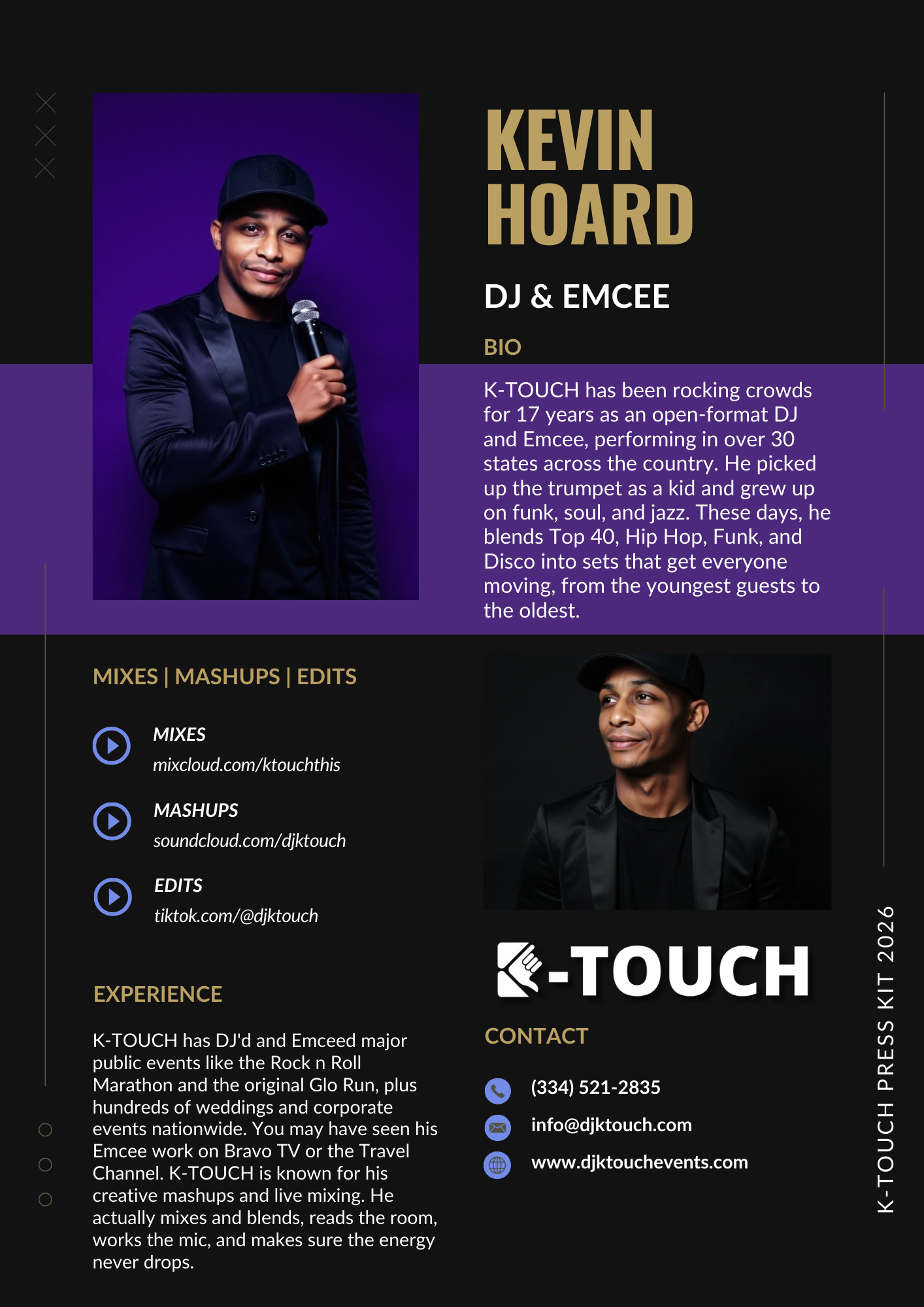
Kevin Hoard (DJ K-TOUCH)
Kevin is the lead DJ and MC behind DJ K-TOUCH Events & Services. He has been DJing Auburn area weddings since 2012 and started DKES in 2019. He has read hundreds of dance floors across Auburn, Opelika, Montgomery, and beyond, and he writes these guides to help couples plan events that actually feel like them.
Let’s Talk About Your Event
Whether it’s a wedding, a school dance, or a company party, Kevin will help you build a night your guests remember. Dates around Auburn book up fast, so reach out early.