Outdoor Festival and Fair DJ Guide for Auburn, AL: Sound Systems, Timelines, and a 5-Step Event Checklist
Key Takeaways
- •Outdoor festivals need purpose-built PA systems, not indoor gear dragged outside. A full line array covers 200 feet; a portable column tops out around 80.
- •Auburn and Opelika enforce noise ordinances after 10 PM on weeknights and 11 PM on weekends. Plan your set list and volume arc around those cutoffs.
- •Generator sizing matters more than speaker wattage. A single 20-amp residential circuit cannot power a festival rig, so budget for a quiet-run inverter generator rated at least 4,000 watts.
- •A 5-step outdoor event sound checklist (permits, power, speaker throw, weather contingency, load-in logistics) prevents the problems that sink amateur setups.
- •Cross-coordinate with food vendors, fire marshals, and stage crews weeks before the event, not the morning of.
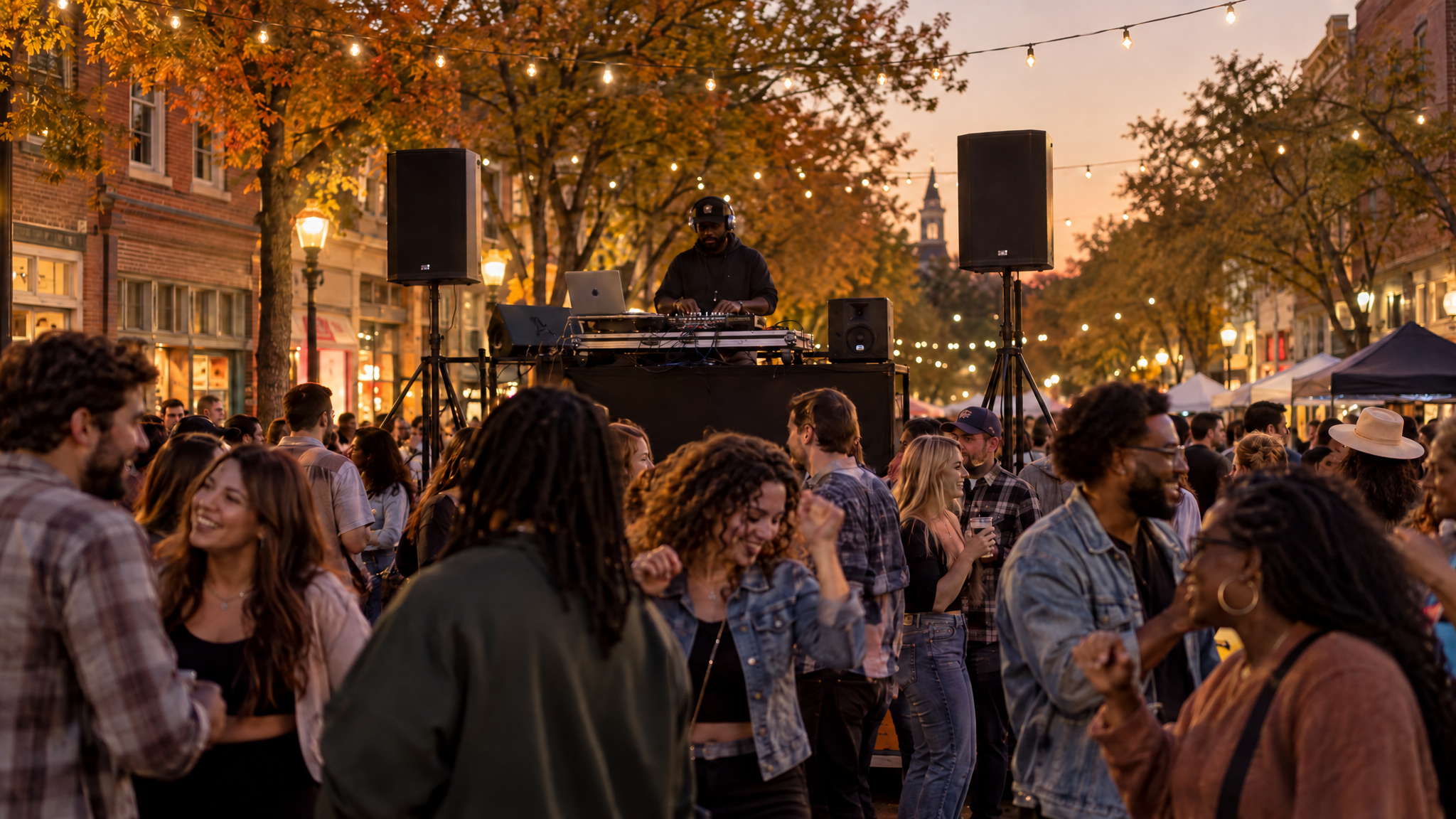
The last Friday evening in October, I rolled my production trailer down North Railroad Avenue in Opelika for their monthly First Friday street event. The city had blocked off two full blocks, and I needed sound to reach from the main stage all the way past the food trucks parked near the railroad crossing, roughly 200 feet of open asphalt with nothing but bodies and folding chairs to absorb the low end. I stacked a pair of line-array tops on each side of the stage, ran two delay speakers on tripods at the halfway mark, and angled a pair of crowd-facing monitors toward the intersection so the folks browsing the art vendors could still feel the kick drum without me blasting the stage mix past 95 dB at the property line. By the time the sun dropped behind the old cotton warehouse and the string lights kicked on, the whole block sounded like one big living room.
That night reminded me why outdoor events are a completely different animal from indoor receptions. The ceiling is the sky, the walls are nonexistent, and the floor is whatever the city paved in 1987. If you are planning an outdoor festival, street fair, fall carnival, or community block party anywhere in the Auburn-Opelika area, this guide covers everything I have learned across 15 years of open-air gigs, from speaker throw math to generator sizing to Auburn's noise ordinances.
Have a festival date locked in and need a DJ who actually owns outdoor-grade production gear? Call or text me at (334) 521-2835 or email [email protected] and I will walk your site with you before we talk setup.
Stage PA vs Portable Column vs Bluetooth: Picking the Right Sound System
The single biggest mistake I see at community events is organizers renting the same speaker package they would use for a 200-person wedding reception and expecting it to fill a city block. Indoor speakers project sound in a controlled space with walls to bounce off. Outdoors, sound dissipates fast because there are no reflective surfaces sending energy back toward the audience. You need more headroom, wider horizontal dispersion, and often a set of delay speakers placed partway into the crowd.
Here is how the three most common outdoor setups compare.
| Factor | Full Line-Array PA | Portable Column System | Bluetooth Party Speaker |
|---|---|---|---|
| Coverage radius | 150 to 250 feet | 60 to 80 feet | 15 to 25 feet |
| Power draw (watts) | 2,400 to 4,800 | 800 to 1,200 | 40 to 100 |
| Setup time | 90 to 120 minutes | 20 to 30 minutes | 5 minutes |
| Subwoofer support | Dual 18-inch subs standard | Single 12-inch sub optional | Built-in 4-inch driver |
| Best for | Festivals, fairs, block parties 300+ people | Vendor areas, small stages, 50 to 150 people | Background music at a single booth |
| Weather resistance | Rigged with rain covers, grounded cables | Moderate with covers | Minimal |
| Cost tier | Highest | Mid-range | Lowest |
| Delay speakers needed | Yes, beyond 100 feet | Rarely | Never |
For most Auburn and Opelika community festivals, I bring the full line-array rig for the main stage and set a pair of portable columns near secondary areas like kids' zones or vendor rows. That layered approach keeps volume manageable at the stage while still giving the outer edges clean, intelligible sound.
Outdoor Festival Timeline: Set Changes, MC Cues, and Vendor Windows
Outdoor events have moving parts that indoor receptions never deal with. You have vendor load-in windows, fire marshal walk-throughs, stage changeovers between acts, and hard noise curfews set by the city. I build every outdoor timeline backward from the noise cutoff, then layer in the coordination windows.
| Time Block | Activity | MC/DJ Cue | dB Target at Property Line |
|---|---|---|---|
| 2:00 PM to 3:00 PM | Load-in, sound check, vendor setup | DJ runs pink noise for speaker alignment | Below 70 dB |
| 3:00 PM to 3:15 PM | Fire marshal walk-through and safety check | Mute all audio during inspection | Silent |
| 3:15 PM to 3:30 PM | Opening remarks, sponsor acknowledgments | MC introduces event, DJ plays walk-on bed | 75 dB |
| 3:30 PM to 5:00 PM | Afternoon set, family-friendly programming | Upbeat pop and country rotation, vendor callouts every 30 minutes | 80 dB |
| 5:00 PM to 5:15 PM | Stage changeover or break | DJ drops to background, MC promotes food vendors | 70 dB |
| 5:15 PM to 7:00 PM | Evening set, higher energy | Dance mix, crowd interaction games, photo ops | 85 dB |
| 7:00 PM to 7:15 PM | Second changeover or featured act intro | MC introduces headliner or featured performer | 75 dB |
| 7:15 PM to 9:30 PM | Peak energy set | Festival bangers, sing-alongs, audience requests | 90 dB |
| 9:30 PM to 9:50 PM | Wind-down set | Slower jams, event thank-yous, sponsor shout-outs | 80 dB |
| 9:50 PM to 10:00 PM | Final song and close | MC closing remarks, DJ plays final track ("Sweet Home Alabama" or "Wagon Wheel") | 75 dB, music off by 10:00 PM |
That 10 PM hard stop is not a suggestion. In Auburn, the city noise ordinance (Chapter 14, Article II of the Auburn Code of Ordinances) sets limits that effectively require amplified music to end by 10 PM on weeknights and 11 PM on Friday and Saturday nights in most commercial and mixed-use zones. Opelika follows a similar framework. I always confirm the specific curfew with the event permit office at least two weeks out, because special event permits sometimes extend the window by an hour.
Festival vs Private Party vs Wedding: Why Outdoor Events Need a Different Approach
Couples planning weddings and corporate teams booking holiday parties sometimes assume their DJ can run a festival the same way. The logistics, gear requirements, and coordination layers are fundamentally different.
| Factor | Outdoor Festival or Fair | Private Backyard Party | Wedding Reception |
|---|---|---|---|
| Typical crowd size | 300 to 2,000+ | 30 to 100 | 100 to 250 |
| Sound coverage area | 10,000 to 40,000 sq ft | 1,000 to 3,000 sq ft | 2,000 to 5,000 sq ft |
| Power source | Generator or utility tie-in | Home circuits or small generator | Venue power |
| Permit required | Yes, noise and event permits | Usually no | Venue handles |
| Coordination contacts | City, fire marshal, vendors, stage crew, sponsors | Host only | Planner, venue coordinator, caterer |
| Weather contingency | Must have rain plan for all gear | Move indoors | Venue provides backup space |
| Set length | 4 to 8 hours with changeovers | 2 to 4 hours continuous | 4 to 5 hours with ceremony |
| MC role | Stage host, sponsor reads, crowd control | Light hosting | Full reception MC |
The coordination load alone is triple what a typical private party requires. I start my festival pre-production calls three to four weeks before the event date, not the week before.
Auburn Noise Ordinances for Outdoor Public Events
This section matters more than most organizers realize. I have watched two community events in the broader Lee County area get shut down mid-set because nobody checked the local noise rules before booking the stage.
Auburn's noise ordinance caps unreasonable amplified sound in residential-adjacent areas, and enforcement officers use handheld SPL meters at the nearest property line to check compliance. Here is what I factor into every outdoor setup:
- Weeknight cutoff: Amplified music should end by 10:00 PM Sunday through Thursday.
- Weekend cutoff: Friday and Saturday events can typically run until 11:00 PM, though special event permits may extend to midnight.
- dB guideline: I keep my property-line readings below 85 dB during peak hours and below 75 dB during the wind-down set. The ordinance language references "unreasonable" noise rather than a fixed dB number, so staying well under typical conversation-distance levels at the boundary is the safest play.
- Permit lead time: Auburn event permits should be submitted at least 30 days in advance. Opelika requires a similar window. I recommend 45 days to account for back-and-forth with the parks department or public works.
- Special zones: Events near Toomer's Corner, the Auburn University campus perimeter, or residential neighborhoods on South College Street have tighter scrutiny. I always do a pre-event site visit to identify the nearest residential property line and measure the distance from my planned speaker positions.
If you are organizing a festival or fair in Auburn or Opelika and want a DJ who already knows the noise rules and has SPL monitoring built into every rig, reach out at (334) 521-2835 or [email protected].
Kevin books a limited number of weddings and events each month across Auburn and the surrounding area. Reach out today and let’s talk about your day.
5-Step Outdoor Event Sound Checklist
I developed this checklist after a spring fair in Smiths Station where I showed up to find no dedicated power drop, a stage facing directly into a neighborhood, and zero rain cover for my gear. That was an expensive lesson. Now I run through these five steps on every outdoor booking before I even quote the gig.
Step 1: Confirm Permits and Noise Windows. Request a copy of the event permit and verify the amplified sound start and stop times. If the permit has not been filed yet, walk the organizer through the application process and flag any restrictions that affect speaker placement or volume.
Step 2: Size the Generator or Confirm Utility Power. Add up the total wattage of every piece of gear in the rig: tops, subs, monitors, lighting, laptop chargers, and backup gear. Multiply by 1.5 for headroom. For a typical festival PA, that means a minimum 4,000-watt inverter generator. I use Honda EU series units because they run quieter than conventional generators, which matters when the generator sits 30 feet from the audience. If the venue offers a utility tie-in, confirm the amperage and breaker location.
Step 3: Calculate Speaker Throw and Delay Placement. Sound loses about 6 dB every time the distance from the speaker doubles. For a 200-foot coverage area, I place delay speakers at the 100-foot mark, time-aligned to the mains using a measurement mic and alignment software. Without delays, the back third of the crowd hears mush instead of music.
Step 4: Build a Weather Contingency Plan. Outdoor gear and rain do not mix. I carry fitted rain covers for every top and sub, route all power cables through waterproof junction boxes, and identify a covered fallback position (pavilion, large tent, or building overhang) where I can relocate the rig in under 15 minutes if a storm cell rolls through. In coastal events near Gulf Shores, I also factor in salt air corrosion and bring extra protective covers.
Step 5: Map Load-In Logistics and Stage Access. Confirm vehicle access to the stage area, unloading zones, and the time window for load-in. City events often close streets hours before the public arrives, so I need to be inside the barricades before they go up. I also confirm forklift or hand-truck access if the stage is elevated, and I bring extra cable runs (minimum 200 feet of XLR and power cable) because outdoor distances always exceed indoor estimates.
Working with Vendors, Fire Marshals, and Stage Crews
A festival is a small city that assembles in a day and disappears by midnight. The DJ is not just the music person. I end up coordinating with food truck operators who need power from the same generator bank, fire marshals who want clear egress lanes near my speaker stacks, and volunteer stage crews who may have never loaded in professional audio gear before.
Here is what I have learned keeps those relationships smooth:
- Share a channel. I set up a group text or walkie-talkie channel with the event organizer, stage manager, and head of vendor operations at least one week before the event. On event day, that channel handles real-time changes like a vendor needing to move their tent away from a speaker, or the fire marshal requesting a cable reroute.
- Print a site map. I mark speaker positions, cable runs, generator placement, and egress paths on a simple overhead map and share it with the fire marshal during the pre-event walk-through. That five-minute conversation has saved me from mid-event shutdowns more than once.
- Brief the stage crew. If volunteers are helping with load-in, I walk them through which cases are fragile (line-array tops), which are heavy (subs, about 90 pounds each), and which cables to never unplug during the show. A two-minute briefing prevents a two-hour problem.
Kevin books a limited number of weddings and events each month across Auburn and the surrounding area. Reach out today and let’s talk about your day.
Photo Booth Add-On for Outdoor Festivals
Festivals are prime photo booth territory. The energy is high, people are dressed up or in costume, and the foot traffic means the booth stays busy the entire event. I typically set up one of our open-air photo booth stations near the main stage entrance or next to the food vendor row, wherever the foot traffic funnels naturally.
For outdoor festivals, the AI photo booth option works especially well because guests can choose themed digital overlays that match the event (fall festival frames, holiday market borders, school spirit graphics) and share directly to their phones without waiting for prints. At a recent Opelika fall market, we processed over 340 photo sessions across five hours, and every single image included the event sponsor's logo as a custom overlay.
If you want to add a photo booth to your outdoor festival or fair, we offer both print stations and digital-only setups depending on your crowd size and budget. Check out our full photo booth options for details.
Songs That Work at Outdoor Festivals (2026 Rotation)
Indoor receptions reward slow builds and emotional peaks. Outdoor festivals reward instant energy and broad appeal. The crowd is walking by, not sitting at assigned tables, so every song needs to hook people within eight bars or they keep moving toward the funnel cake stand.
Here is my current outdoor festival rotation for fall 2026:
- "Cruel Summer" by Taylor Swift (still filling dance floors two years after peak radio play)
- "Espresso" by Sabrina Carpenter (the singalong factor is off the charts at college-town events)
- "Texas Hold 'Em" by Beyonce (country-pop crossover that works in Auburn and Opelika)
- "Wagon Wheel" by Darius Rucker (mandatory for any outdoor event south of the Mason-Dixon line)
- "Buy Dirt" by Jordan Davis (slower tempo, perfect for the sunset wind-down set)
- "Save a Horse (Ride a Cowboy)" by Big & Rich (instant crowd reaction at every Southern festival I have ever worked)
- "Yeah!" by Usher (throwback energy that crosses every age group)
- "Sweet Home Alabama" by Lynyrd Skynyrd (the closer, every single time)
I rotate about 40 percent of this list per event based on the crowd demographic. A family-focused fall festival gets more country and classic rock. A college-adjacent block party gets more pop and hip-hop. The core principle stays the same: outdoor sets need songs with big choruses that carry across open space.
Frequently Asked Questions
How loud can a DJ play at an outdoor festival in Auburn, AL?
Auburn's noise ordinance limits unreasonable amplified sound near residential areas. I keep property-line readings below 85 dB during peak hours and reduce to 75 dB during the wind-down, ending music by 10 PM on weeknights or 11 PM on weekends.
What size generator do I need for outdoor festival DJ equipment?
A full festival PA with subs, tops, monitors, and lighting draws 2,400 to 4,800 watts. I recommend a minimum 4,000-watt inverter generator with 1.5x headroom. Honda EU series units run quieter than conventional generators.
How far in advance should I book a DJ for an outdoor festival?
Book at least 6 to 8 weeks out for fall and spring festival season. October and April weekends fill fastest in the Auburn area. For a full planning timeline, read our booking guide.
Can DJ K-TOUCH provide sound for both the main stage and vendor areas?
Yes. I run a layered system with a full line-array PA on the main stage and portable column speakers at secondary areas like kids' zones or vendor rows, all controlled from one mixing board.
What happens if it rains during an outdoor festival?
I carry fitted rain covers for every speaker and subwoofer, use waterproof junction boxes for power cables, and pre-identify a covered fallback position where the rig can relocate in under 15 minutes.
Does DJ K-TOUCH handle event permits for outdoor sound?
I do not file the permits, but I walk organizers through the application process, confirm noise windows, and provide a site map with speaker positions for the fire marshal walk-through.
Can I add a photo booth to my outdoor festival booking?
Absolutely. Our AI photo booth and open-air print stations are built for high-traffic outdoor events. At a recent Opelika fall market, we ran over 340 sessions in five hours with custom sponsor overlays.
Ready to lock in professional outdoor sound for your next Auburn or Opelika festival, street fair, or community event? Call or text DJ K-TOUCH at (334) 521-2835, email [email protected], or check out our full event rental options and corporate event services to see what we bring to the stage.
Frequently Asked Questions
How loud can a DJ play at an outdoor festival in Auburn, AL?
Auburn limits unreasonable amplified sound near residential areas. I keep property-line readings below 85 dB during peak hours, reduce to 75 dB during wind-down, and end music by 10 PM weeknights or 11 PM weekends.
What size generator do I need for outdoor festival DJ equipment?
A full festival PA draws 2,400 to 4,800 watts. I recommend a minimum 4,000-watt inverter generator with 1.5x headroom. Honda EU series units run quieter than conventional models.
How far in advance should I book a DJ for an outdoor festival?
Book at least 6 to 8 weeks out for fall and spring festival season. October and April weekends fill fastest in the Auburn-Opelika area.
Can DJ K-TOUCH provide sound for both the main stage and vendor areas?
Yes. I run a layered system with a full line-array PA on the main stage and portable column speakers at secondary areas, all controlled from one mixing board.
What happens if it rains during an outdoor festival?
I carry rain covers for every speaker, use waterproof junction boxes, and pre-identify a covered fallback position where the rig can relocate in under 15 minutes.
Does DJ K-TOUCH handle event permits for outdoor sound?
I do not file permits, but I walk organizers through the application, confirm noise windows, and provide a site map with speaker positions for the fire marshal walk-through.
Can I add a photo booth to my outdoor festival booking?
Absolutely. Our AI photo booth and open-air print stations handle high-traffic outdoor events. At a recent Opelika fall market we ran over 340 sessions in five hours.
About the Author
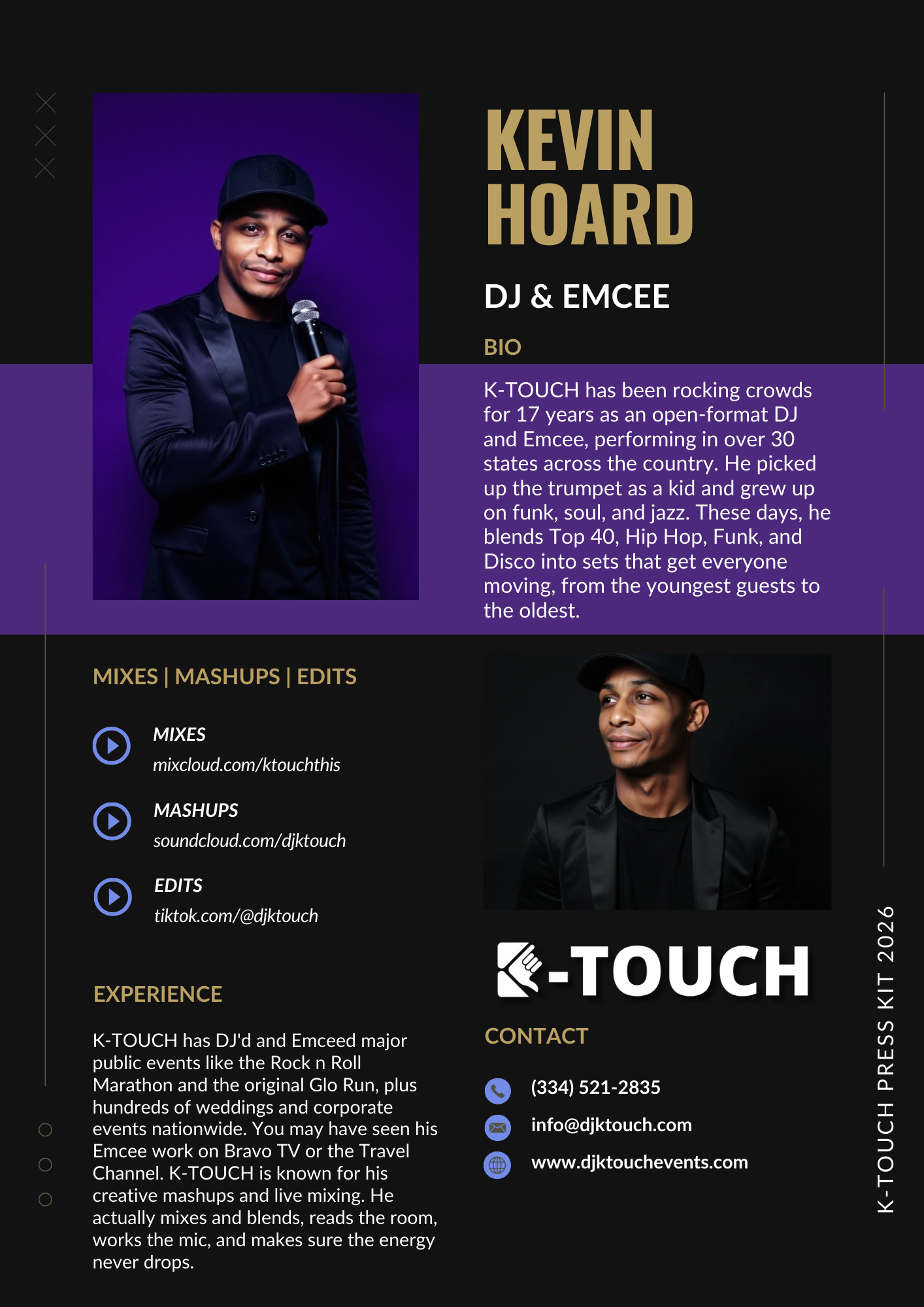
Kevin Hoard (DJ K-TOUCH)
Kevin is the lead DJ and MC behind DJ K-TOUCH Events & Services. He has been DJing Auburn area weddings since 2012 and started DKES in 2019. He has read hundreds of dance floors across Auburn, Opelika, Montgomery, and beyond, and he writes these guides to help couples plan events that actually feel like them.
Let’s Talk About Your Event
Whether it’s a wedding, a school dance, or a company party, Kevin will help you build a night your guests remember. Dates around Auburn book up fast, so reach out early.