Church Fellowship Hall DJ Guide for Auburn, AL: Acoustics, Timelines, and a 5-Step Booking Checklist
Key Takeaways
- •Fellowship hall acoustics vary wildly by floor and ceiling type, so a site visit with a sound meter is non-negotiable before any church event.
- •A choir-to-DJ handoff works best when the DJ pre-cues a low-volume dinner groove that fades up as the last hymn ends.
- •Working with an existing church soundboard saves setup time and money, but always bring a backup mixer and cables.
- •Church coordinators should book their DJ at least 6 to 8 weeks out, especially during fall fundraiser season.
- •Keeping volume at or below 85 dB during dinner and 90 dB during dancing respects the congregation and neighboring classrooms.
Why Church Fellowship Halls Are One of My Favorite Rooms to DJ
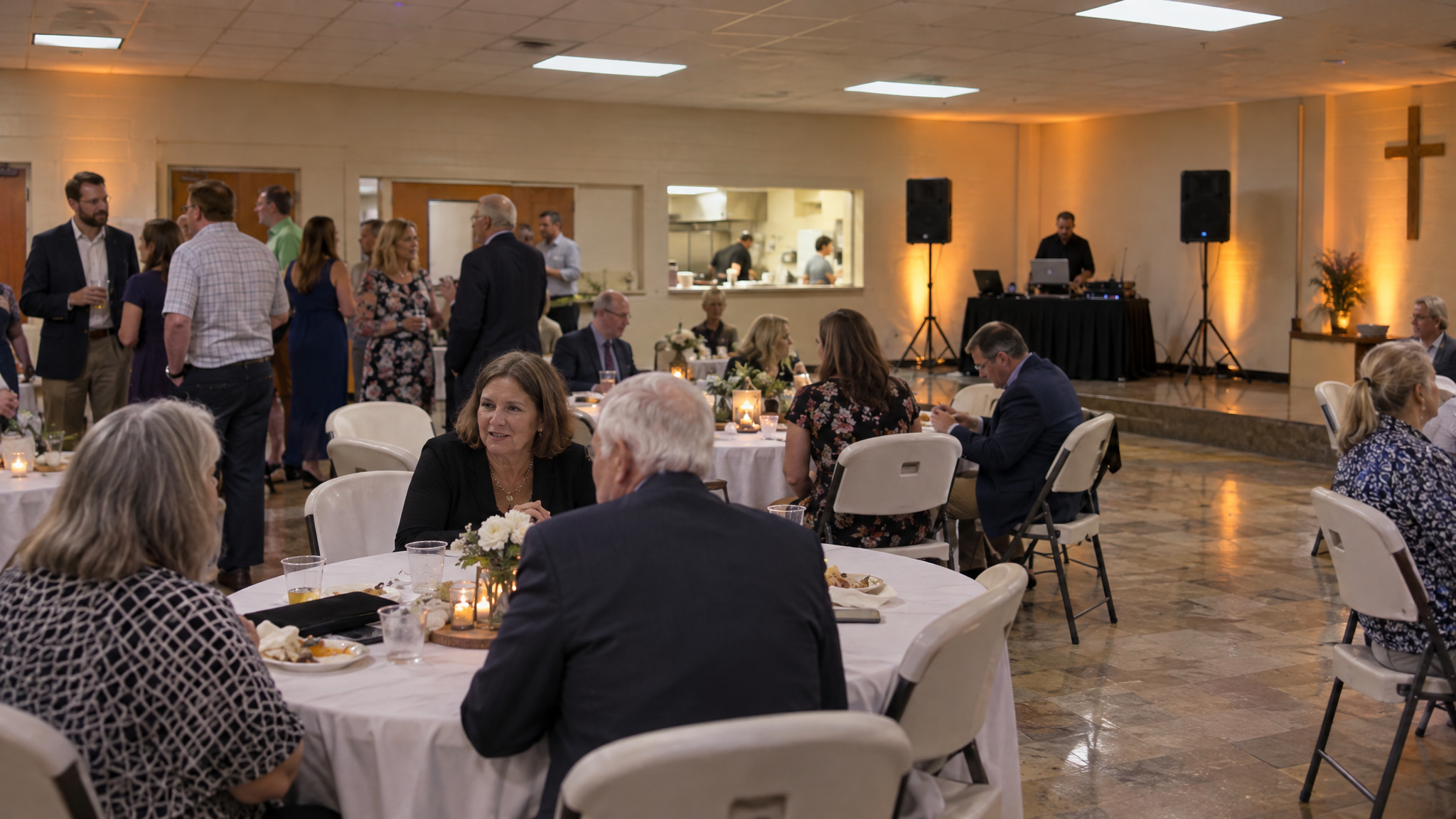
I pulled into the parking lot at Auburn United Methodist on a Friday evening last October, rolling two QSC K12.2s and a milk crate of XLR cables through the side door of the fellowship hall. Inside, the women's ministry team was putting finishing touches on centerpieces while a four-voice choir warmed up near the kitchen pass-through. The event was a fundraiser dinner for the local food pantry, and my job was simple on paper: keep background music rolling during the three-course meal, handle the choir-to-DJ handoff at dessert, then bring the energy up just enough for a 45-minute dance set before the pastor's closing prayer.
That night reminded me why I genuinely love working fellowship halls. They are humble, familiar, community-anchored rooms, and the people who gather in them are there because they care about something bigger than a party. But the acoustics? Those can be tricky. Tile floors, drop ceilings, cinderblock walls, and a kitchen that echoes every pot clang into the main room. If you do not plan your sound setup carefully, a fellowship hall will punish you.
This guide walks church coordinators, event committees, and ministry leaders through everything I have learned about DJing fellowship hall events in Auburn, Opelika, and across Lee County. Whether you are planning a fundraiser banquet, a church anniversary celebration, a Vacation Bible School family night, or a youth group lock-in, these tips will save you stress and make your event sound incredible. If you want to talk specifics for your church, call or text me at (334) 521-2835 or email [email protected].
Fellowship Hall Acoustics: Why Every Room Sounds Different
Not all fellowship halls are built the same. I have worked rooms at First Baptist Opelika that have thick carpet and acoustic ceiling tiles (almost too dead, honestly), and I have worked the gym-style hall at Lakeview Baptist where every snare hit bounces off polished concrete for what feels like two full seconds. Understanding your room's acoustic profile is the single most important step before choosing speaker placement, EQ settings, and volume targets.
Here is a quick comparison of the three most common fellowship hall floor types I encounter in the Auburn area:
| Feature | Carpeted Hall | Tile Floor Hall | Gym-Style (Polished Concrete) |
|---|---|---|---|
| Reverb Level | Low (sound absorbed) | Moderate (some reflection) | High (significant echo) |
| Speaker Placement | Stands at 6 ft, pointed slightly down | Stands at 7 ft, angled toward audience center | Stands at 5 ft, aimed low to reduce ceiling bounce |
| EQ Adjustment | Boost highs slightly, mids flat | Cut low-mids by 2-3 dB | Cut lows and low-mids by 3-5 dB, roll off below 60 Hz |
| Recommended Max dB (Dinner) | 80 dB | 82 dB | 78 dB |
| Recommended Max dB (Dancing) | 90 dB | 88 dB | 85 dB |
| Best Use Case | Banquets, seated programs | Mixed dinner-and-dance events | Youth events, large group games |
I always do a site visit at least two weeks before the event. I bring a small Bluetooth speaker and play a test track at conversation volume while walking the room. If I hear noticeable echo from more than 20 feet away, I know I need to adjust my rig and potentially bring sound-absorbing panels or position speakers closer to the audience.
Kevin books a limited number of weddings and events each month across Auburn and the surrounding area. Reach out today and let’s talk about your day.
The Choir-to-DJ Handoff: Getting the Transition Right
Many church events feature live music, a praise team set, or a choir performance before the DJ takes over. The handoff between live and recorded music is one of those moments that either feels seamless or painfully awkward. I have refined a process that works every time.
Here is the step-by-step:
- Pre-cue a dinner groove. Before the choir finishes, I load a soft instrumental track (something like a jazz piano version of "What a Wonderful World" by Louis Armstrong) at about 15% volume on my controller.
- Watch for the final hymn's last chorus. I coordinate with the choir director beforehand so I know the ending.
- Fade up as applause begins. While guests are clapping, I bring the dinner groove from 15% to about 40% over eight seconds. It fills the silence without competing with the applause.
- Hold dinner volume for 10 minutes. This lets guests settle back into conversation before I introduce any uptempo tracks.
The key is communication. I always swap cell numbers with the choir director or worship leader at the site visit so we can text each other during the event if timing shifts.
Run-of-Show Timeline for a Typical Church Fundraiser or Banquet
Church events run on a tight clock. The pastor wants to close by 9:00 PM, the kitchen crew needs to start cleanup by 8:30, and the silent auction has to wrap before the main speaker. Here is a timeline template I use for most fellowship hall fundraisers in the Auburn area:
| Time | Event Segment | DJ/MC Role | Volume Target |
|---|---|---|---|
| 5:30 PM | Doors open, guest arrival | Soft background jazz/gospel instrumentals | 70 dB |
| 6:00 PM | Welcome and opening prayer | Fade music to zero, hand mic to pastor | Mic only |
| 6:10 PM | Dinner service begins | Dinner playlist: Motown, classic soul, soft R&B | 75 dB |
| 6:45 PM | Choir or praise team performance | Mute DJ rig, monitor choir through house system | N/A |
| 7:10 PM | Choir-to-DJ handoff (dessert) | Fade in dinner groove per handoff process above | 72 dB |
| 7:30 PM | Keynote speaker or program | Fade music to zero, manage wireless mic | Mic only |
| 7:55 PM | Fundraiser results announcement | Provide drumroll sound effect on cue | Brief |
| 8:00 PM | Dance set or social hour | Uptempo mix: line dances, crowd favorites, 2026 hits | 85 dB |
| 8:25 PM | Last song announcement | MC: "Last song of the evening" | 82 dB |
| 8:30 PM | Closing prayer, send-off | Fade to soft exit music, hold until room clears | 65 dB |
I print two copies of this timeline: one for me and one for the event coordinator. We both mark it up during the site visit so there are no surprises on event night.
DJ vs. Playlist vs. Live Musician: What Works Best for Church Events
I get this question a lot from church committees trying to stay within budget. Here is an honest comparison based on what I have seen across dozens of church events in Lee County:
| Factor | Professional DJ | Spotify/Playlist | Live Musician (Solo) |
|---|---|---|---|
| Cost Range | Mid-range (call for quote) | Free (plus speaker rental) | Varies widely |
| Song Variety | Unlimited, on-the-fly requests | Fixed playlist, no flexibility | Limited to performer's repertoire |
| MC Capability | Yes, announcements, intros, transitions | None | Rarely |
| Sound Quality | Professional PA, EQ'd for room | Depends on speaker quality | Depends on amplification |
| Crowd Reading | Real-time adjustments | No adjustments | Limited |
| Church AV Integration | Full (see next section) | Basic aux cable | May need own amp |
| Setup/Teardown | 60-90 min total | 10 min | 30-60 min |
| Best For | Dinner-to-dance events, fundraisers, large groups | Small Bible study socials, background-only events | Intimate worship-adjacent gatherings |
A playlist works fine for a 20-person Bible study potluck. But the moment you have 80 guests, a program with multiple speakers, and a dance segment, you need someone managing sound levels, transitions, and mic handoffs in real time. That is what I do.
Working with Church AV Systems and Existing Soundboards
This is where a lot of outside DJs get tripped up. Many churches have a built-in sound system: ceiling speakers, a mixing board in a booth or closet, wireless mic receivers, and sometimes a monitor system for the choir. Some of these setups are excellent. Some have not been updated since 2004.
Here is my approach:
During the site visit, I ask the church's AV volunteer (every church has one) to walk me through the board. I note the brand, channel count, and output options. Most churches in the Auburn area run a Yamaha MG series or a Behringer X32. If the board has an open stereo aux return or a dedicated channel pair, I can feed my DJ output directly into the house system, which means the ceiling speakers carry my music alongside the existing wireless mics.
Why this matters: Using the house system means I do not need to set up my own PA for background dinner music. The ceiling speakers distribute sound evenly across the room, which is actually better than two floor-standing mains for low-volume background music in a rectangular hall.
When I bring my own rig anyway: If the event includes a dance segment above 82 dB, ceiling speakers typically cannot handle the low end. I set up my QSCs for the dance set and run them in parallel, fading the ceiling speakers down as the dance volume comes up.
Backup gear I always carry for church events:
- A 4-channel mixer (in case the house board is locked or malfunctioning)
- Two 25-foot XLR cables and a 1/4-inch-to-XLR adapter
- A wireless mic with fresh batteries (church mics sometimes have dead batteries)
- A Bluetooth receiver as a last-resort input option
If your church has an AV team that handles Sunday services, loop them in early. They know the quirks of the system better than anyone, and they usually appreciate being asked rather than bypassed.
Kevin books a limited number of weddings and events each month across Auburn and the surrounding area. Reach out today and let’s talk about your day.
5-Step Booking Checklist for Church Event Coordinators
If you are on a church event committee and you have never hired a DJ before, this checklist will keep you organized:
Step 1: Confirm the fellowship hall's rules. Some churches have volume limits, no-secular-music policies, or restrictions on fog/haze machines. Ask the church administrator before you book anyone.
Step 2: Schedule a site visit with your DJ. A good DJ will want to see the room, test acoustics, and meet your AV volunteer. If a DJ says they do not need a site visit, that is a red flag. I offer free site visits for every church event in the Auburn and Opelika area.
Step 3: Share your program outline at least two weeks out. Send your DJ the run-of-show, speaker list, any special songs (the couple's anniversary song, the youth group's theme song), and the name and number of your choir director or worship leader.
Step 4: Confirm load-in logistics. Fellowship halls often have narrow hallways, stairs, or limited parking near the entrance. Let your DJ know which door to use, where to park the van, and whether there is a dolly available. I once carried a subwoofer up a flight of stairs at a church in Phenix City because no one mentioned the fellowship hall was on the second floor.
Step 5: Do a final walkthrough the day before. Meet your DJ at the hall, confirm table layout, point out the electrical outlets, and run through the timeline one more time. This 20-minute meeting prevents 90% of day-of surprises.
Need help planning your next church event? I have worked fundraisers, anniversary banquets, VBS family nights, youth lock-ins, and church picnic after-parties across Auburn, Opelika, Smiths Station, and Phenix City. Call or text me at (334) 521-2835 or send a note to [email protected] and let's make your fellowship hall sound better than it ever has.
Songs That Work in Every Fellowship Hall
Song selection for church events requires a little more thought than a typical private party. You want music that fits the congregation's comfort zone while still keeping energy up during the dance set. Here are some tracks I keep in heavy rotation for church events in 2026:
Dinner/Background:
- "Stand By Me" by Ben E. King
- "Lovely Day" by Bill Withers
- "Best Part" by Daniel Caesar and H.E.R.
- "Golden" by Jill Scott
Dance Set (Family-Friendly):
- "Before I Let Go" by Frankie Beverly and Maze
- "September" by Earth, Wind and Fire
- "Uptown Funk" by Bruno Mars
- "Happy" by Pharrell Williams
- "Good as Hell" by Lizzo (clean version)
- "Texas Hold 'Em" by Beyonce
Line Dances (Always Crowd Favorites):
- "Cupid Shuffle" by Cupid
- "Cha Cha Slide" by DJ Casper
- "Electric Slide" (traditional)
- "Wobble Baby" by V.I.C.
I always ask the event coordinator if there are any songs the pastor or church leadership would prefer I skip. A two-minute conversation about music boundaries prevents any awkward moments during the event.
Frequently Asked Questions About Church Fellowship Hall DJ Services
Q: How loud can a DJ play in a fellowship hall? I keep dinner music at 70 to 78 dB and dance sets at 85 to 90 dB depending on the room. I always confirm volume limits with the church before the event.
Q: Can you use the church's existing sound system? Yes. I integrate with most church soundboards for background music and bring my own PA for louder dance segments when needed.
Q: Do you play secular music at church events? I follow whatever guidelines the church sets. Many fellowship hall events mix gospel, Motown, and clean pop. I always get approval on the playlist beforehand.
Q: How early should we book a DJ for a church fundraiser? Six to eight weeks is ideal, especially during fall fundraiser season (September through November) when church calendars fill up quickly.
Q: What if our fellowship hall has bad acoustics? I do a free site visit to test the room and adjust my setup accordingly. Speaker placement, EQ, and volume targets all change based on floor type and ceiling height.
Q: Do you bring your own equipment or use the church's? Both. I use the church's ceiling speakers for background music when possible and bring my own PA system for dance sets and higher-volume segments.
Q: Can you MC the program, introduce speakers, and make announcements? Absolutely. MC services are included with every DJ booking. I coordinate with your event chair to handle introductions, prayer cues, and auction announcements.
Ready to book DJ K-TOUCH for your next church fellowship hall event? Reach out at (334) 521-2835 or [email protected]. I serve churches across Auburn, Opelika, Lee County, and the greater East Alabama area through DKES private event services and corporate event packages.
Frequently Asked Questions
How loud can a DJ play in a fellowship hall?
Dinner music stays at 70 to 78 dB and dance sets at 85 to 90 dB depending on the room. Volume limits are confirmed with the church before every event.
Can you use the church's existing sound system?
Yes. I integrate with most church soundboards for background music and bring my own PA for louder dance segments when the ceiling speakers cannot handle the low end.
Do you play secular music at church events?
I follow whatever guidelines the church sets. Many events mix gospel, Motown, and clean pop. Playlists are approved beforehand.
How early should we book a DJ for a church fundraiser?
Six to eight weeks is ideal. Fall fundraiser season fills calendars quickly, so booking early locks in your preferred date.
What if our fellowship hall has bad acoustics?
I do a free site visit to test the room and adjust speaker placement, EQ, and volume targets based on floor type and ceiling height.
Do you bring your own equipment or use the church's?
Both. Church ceiling speakers handle background music well. I bring my own PA for dance sets and higher-volume segments.
Can you MC the program and introduce speakers?
Yes. MC services are included with every booking. I coordinate introductions, prayer cues, and announcements with your event chair.
About the Author
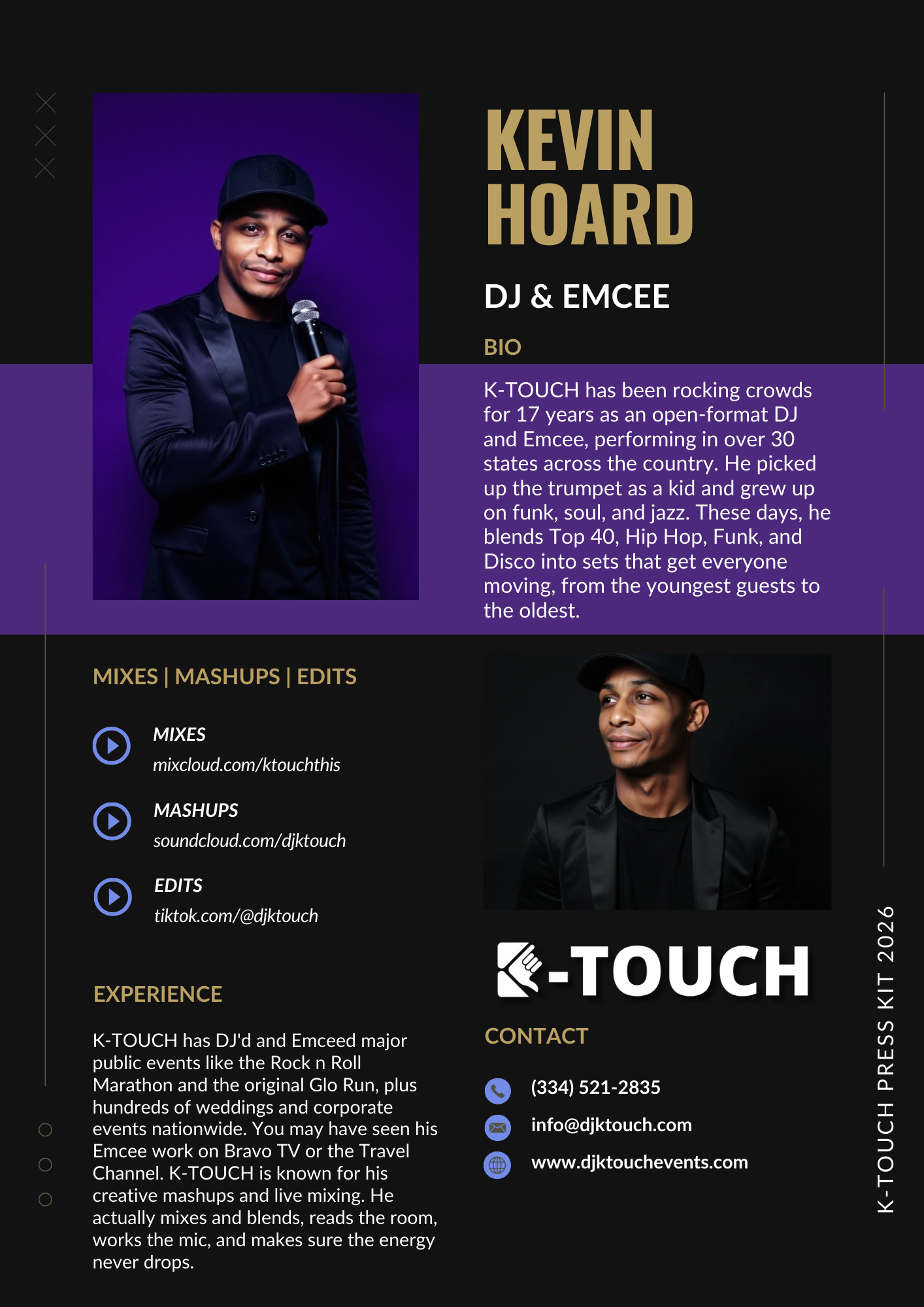
Kevin Hoard (DJ K-TOUCH)
Kevin is the lead DJ and MC behind DJ K-TOUCH Events & Services. He has been DJing Auburn area weddings since 2012 and started DKES in 2019. He has read hundreds of dance floors across Auburn, Opelika, Montgomery, and beyond, and he writes these guides to help couples plan events that actually feel like them.
Let’s Talk About Your Event
Whether it’s a wedding, a school dance, or a company party, Kevin will help you build a night your guests remember. Dates around Auburn book up fast, so reach out early.