
Lakefront Wedding Reception DJ Guide: Sound Over Water, Sunset Timelines, and Venue Tips for Auburn Couples
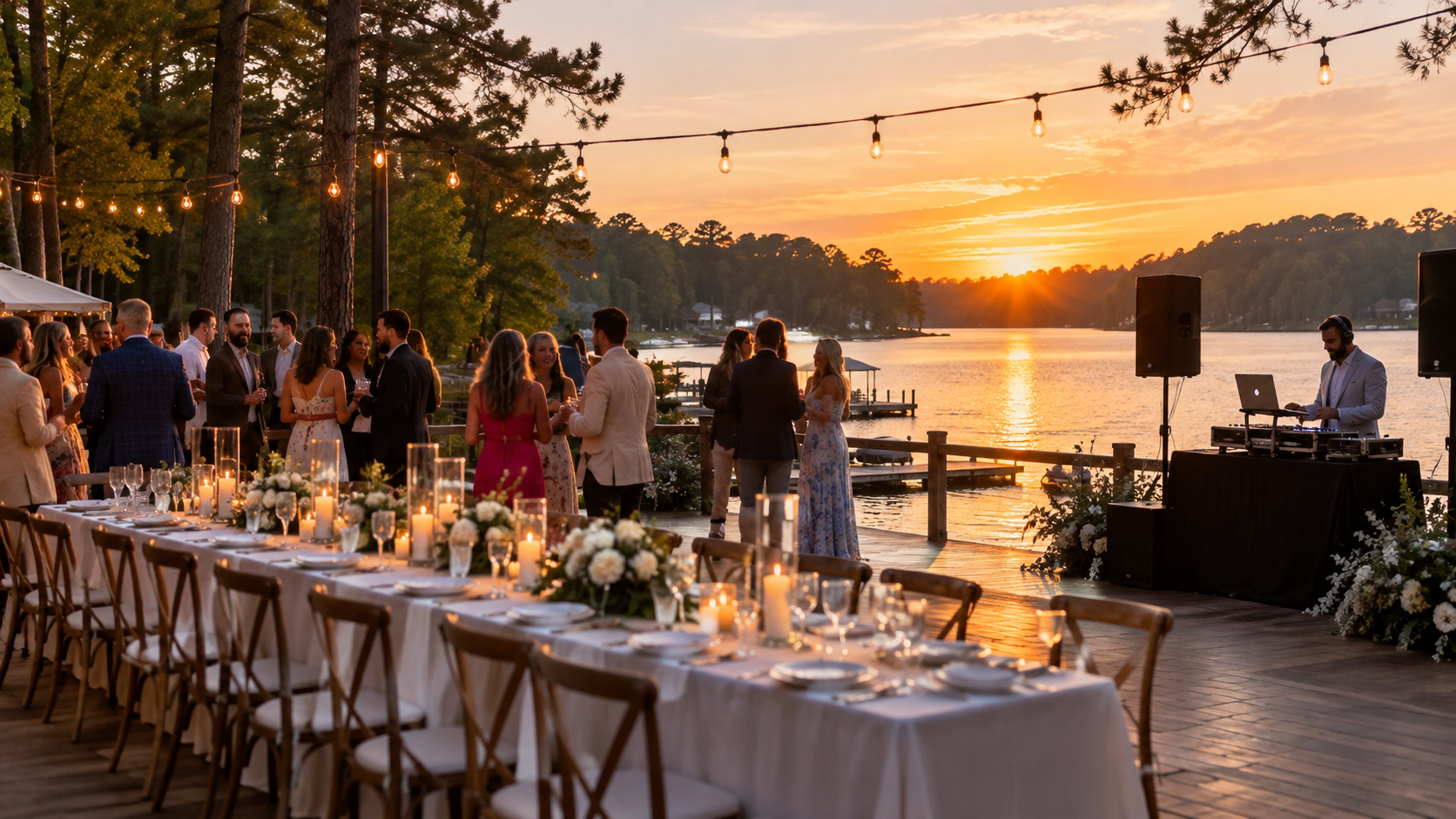
Key Takeaways
- •Sound travels farther and louder over flat water, so speaker angle and sub placement matter more at a lakefront reception than at any indoor venue.
- •A ceremony-to-cocktail-to-reception timeline with built-in buffer keeps your sunset photos on schedule without dead air for guests.
- •Generator placement, dock load limits, and HOA noise rules are lakefront-specific logistics that most couples overlook until the week of the wedding.
- •A lakefront-vs-barn-vs-ballroom comparison helps you weigh acoustics, weather risk, power access, and capacity before you sign a contract.
The first time I ran sound for a lakefront wedding, it was a late-May ceremony on a private dock at Lake Martin. The couple wanted their vows right at the water's edge, and I set up a pair of column speakers flanking the arbor about six feet back from the railing. During rehearsal the evening before, I noticed something strange. The officiant's voice was carrying clear across the cove, bouncing off the opposite shoreline and coming back as a faint echo about two seconds later. A guest on the neighbor's dock, easily 200 yards away, waved and said he could hear every word. That night I angled the speakers inward, dropped the gain by 3 dB, and aimed the subs toward the tree line instead of the open water. The ceremony the next day sounded warm, intimate, and echo-free. That single experience taught me more about waterfront acoustics than any manual ever could.
If you are planning a lakefront wedding reception anywhere near Auburn, Opelika, or the Lake Martin corridor, this guide covers exactly what I have learned across dozens of waterfront events. I will walk you through speaker placement over water, ceremony-to-reception timelines built around golden hour, venue comparisons, power planning, weather contingency, and a booking checklist you can hand straight to your coordinator. Call or text me at (334) 521-2835 or email [email protected] and let's start mapping out your waterfront timeline.
Why Lakefront Acoustics Are Different from Every Other Venue
Water is a nearly perfect sound reflector. Unlike grass, carpet, or even concrete, a flat lake surface does not absorb low-frequency energy. It skips it forward like a stone. That means a subwoofer pointed toward open water will push bass hundreds of yards with almost no loss, and neighbors across the cove will hear your reception playlist as clearly as your head table does.
Here is what that means for setup:
- Speaker angle matters. I aim main tops at the dance floor and guest tables, never out toward the water. Even a 15-degree outward tilt can add 6 dB at the far shoreline.
- Sub placement is critical. I tuck the subwoofer under the deck, behind a wall, or shield it with the DJ table so low-end energy radiates toward the reception area and not across the lake.
- Ceremony monitors need restraint. For vows, I use a single 8-inch monitor on a short stand aimed at the couple and officiant rather than a full PA pointed at guests. Guests hear naturally through proximity, and the opposite shore stays quiet.
- Wind changes everything. A 10 mph breeze blowing off the water toward your guests is free amplification. The same breeze blowing from behind you toward the water steals volume fast. I always pack a second monitor and a wireless mic clip as insurance.
The general rule I follow: run 3 to 5 dB quieter at a lakefront venue than you would in a ballroom, and let the reflective surface do the rest.
Lakefront vs Barn vs Ballroom: A Venue Comparison for Auburn Couples
Choosing between a waterfront property, a rustic barn, and a traditional ballroom changes almost every logistical decision. This table breaks down the differences I see most often.
| Factor | Lakefront / Dock | Barn (e.g., Barn at Shiloh Creek) | Ballroom (e.g., Hotel at Auburn University) |
|---|---|---|---|
| Acoustics | Reflective water surface, minimal absorption, echo risk over open cove | Hard wood walls, exposed rafters, moderate reverb | Carpeted floors, acoustic panels, controlled reverb |
| Weather risk | High (wind, rain, temperature swings, lightning) | Moderate (covered but open-wall barns catch wind) | Low (fully climate-controlled) |
| Power access | Often generator-only at private docks; marina venues may have 30-amp shore power | Usually generator or single residential circuit | Full venue power, dedicated circuits |
| Guest capacity | 50 to 150 typical for dock/deck receptions | 100 to 250 depending on barn footprint | 150 to 400 in most Auburn ballrooms |
| Ceremony sound needs | Low-profile monitors, careful aim away from water | Mid-level PA, watch for rafter reflections | Standard PA with house sound option |
| Sunset/golden hour factor | Major selling point, ceremony timing is everything | Nice but not the centerpiece | Not applicable |
| Generator noise management | Must place 75+ feet from ceremony with baffling | 50+ feet, use barn structure as sound block | Not needed |
If your heart is set on a waterfront ceremony with a dock reception, the acoustic and logistical challenges are real but completely manageable with the right DJ and a solid advance walkthrough. I have run receptions on private docks at Lake Martin, on the pavilion at Chewacla State Park, and on covered patios at Wind Creek Marina, and every one of them sounded incredible once we dialed in the angles.
Ceremony-to-Cocktail-to-Reception Timeline with DJ Cues
Lakefront weddings live and die by the sunset window. In east Alabama, golden hour runs roughly 6:15 to 7:00 PM in June and 4:45 to 5:30 PM in December. I build every waterfront timeline backward from that window so the couple gets their photos on the dock with the sun behind them.
| Time Block | What Happens | DJ / Sound Cue | dB Target |
|---|---|---|---|
| 4:00 PM | Guest arrival, pre-ceremony acoustic playlist | Soft acoustic set through ceremony monitors (Jack Johnson, Norah Jones, Colbie Caillat) | 65 dB at front row |
| 4:30 PM | Ceremony begins, processional | Processional track through ceremony PA, fade at officiant cue | 70 dB processional, 0 dB during vows |
| 5:00 PM | Ceremony ends, recessional | Recessional song (couple's pick), then transition to cocktail playlist | 72 dB recessional |
| 5:05 PM | Cocktail hour on upper deck/lawn | Upbeat lounge playlist through cocktail speakers (Sade, H.E.R., Tom Misch) | 68 dB at cocktail area |
| 5:05 to 5:45 PM | Couple's sunset photos on dock | Cocktail music continues, no MC announcements | 68 dB maintained |
| 5:50 PM | MC calls guests to reception area | MC announcement with gentle music fade | 72 dB announcement |
| 6:00 PM | Grand entrance, first dance | Entrance song through main PA, spotlight if available | 78 dB entrance, 75 dB first dance |
| 6:15 PM | Toasts and dinner | Background dinner music (Motown, soul, R&B), mic for toasts | 65 dB music, toast mic at 72 dB |
| 7:15 PM | Cake cutting, bouquet/garter | Upbeat cue songs, MC direction | 75 dB |
| 7:30 PM | Open dance floor | Full dance playlist, build energy through the night | 80 to 85 dB, check neighbor threshold |
| 9:30 PM | Last dance and sparkler send-off | Slow final song, fade, transition to send-off track | 78 dB last dance |
The 5:05 to 5:45 PM photo window is the single most important buffer in a lakefront timeline. If the ceremony runs 10 minutes long, you still catch golden hour. If it ends early, you get extra candid shots. I always tell couples: protect that window and everything else falls into place.
Generator vs Venue Power: What Your Dock Can Actually Handle
Most private lakefront properties run on standard 15-amp residential circuits. A single circuit gives you about 1,800 watts. My full wedding rig, two tops, a sub, lighting, and a laptop, draws around 2,400 watts at peak. That math does not work on one circuit.
Here is how I solve it:
| Power Source | Wattage Available | Pros | Cons |
|---|---|---|---|
| Single residential circuit (15A) | ~1,800W | No extra cost, quiet | Not enough for full PA + lighting |
| Two dedicated circuits (15A each) | ~3,600W | Sufficient for most setups | Requires long extension runs, breaker risk |
| Portable generator (3,500W inverter) | 3,500W continuous | Reliable, independent, no breaker trips | Noise (must place 75+ feet away), fuel logistics |
| Marina shore power (30A) | ~3,600W | Clean power, no generator noise | Only available at marina venues, adapter needed |
For private dock receptions, I bring a Honda EU3000iS inverter generator. It runs at 49 dB from 23 feet, which is quieter than most conversations. I place it at least 75 feet from the ceremony area, behind a vehicle or structure, with a 100-foot 10-gauge extension cable. The couple never hears it, and I never worry about tripping a breaker during the father-daughter dance.
Kevin books a limited number of weddings and events each month across Auburn and the surrounding area. Reach out today and let’s talk about your day.
Weather Contingency: Wind, Rain, and Lightning Protocols
Outdoor waterfront events carry more weather risk than any other venue type. Here is the protocol I follow for every lakefront wedding.
Wind thresholds:
- Under 10 mph: no adjustments needed, standard setup.
- 10 to 15 mph: add a second monitor for ceremony, switch to wired mics if wireless signal drifts.
- 15 to 20 mph: move ceremony speakers behind the wedding party (upwind), add sandbags to speaker stands.
- Over 20 mph sustained: recommend moving ceremony to covered patio or indoor backup.
Rain plan: I pack waterproof tarps sized to cover my entire rig in under three minutes. Every cable connection gets a weatherproof boot. If rain is forecast above 40% for the ceremony window, I recommend setting up under a tent or covered dock section from the start rather than scrambling mid-vows.
Lightning: If lightning is detected within 10 miles, I power down all equipment immediately. This is non-negotiable. I monitor a weather radar app and communicate with the coordinator 30 minutes before ceremony start. We agree on a go/no-go call at T-minus-15.
Having a Plan B does not mean your wedding is ruined. Some of my most memorable receptions happened when we moved to the covered boathouse 20 minutes before a summer thunderstorm rolled through. The rain on the tin roof became the soundtrack to the first dance, and the couple still talks about it.
HOA and Marina Noise Rules You Need to Know
Lake Martin, Smith Lake, and most private lake communities in Alabama have HOA covenants that restrict amplified music. Here are the most common rules I encounter:
- Still Waters (Lake Martin): Amplified music must end by 10:00 PM. Complaints trigger a formal review.
- The Ridge (Lake Martin): Outdoor amplified sound limited to 9:00 PM on weekdays, 10:00 PM on weekends.
- Wind Creek Marina: Events on the pavilion must keep volume below 85 dB at the property line. No amplified music after 10:00 PM.
- Private docks (general): Most lake associations ask for "reasonable" volume with a hard stop by 10:00 PM.
I always call the HOA or marina office before the event to confirm current rules, get a contact number for the on-duty manager, and let them know the timeline. That one phone call prevents 90% of noise complaints.
5-Step Lakefront Wedding DJ Booking Checklist
Use this checklist when you start planning your waterfront reception.
Step 1: Schedule a venue walkthrough. Walk the dock, deck, or pavilion with your DJ at least 8 weeks before the wedding. Note power outlet locations, dock load limits, shade coverage, and the sunset angle for your date.
Step 2: Confirm power source. Decide between venue circuits, generator, or shore power. If using a generator, confirm placement distance and fuel access.
Step 3: Build the timeline around golden hour. Use a sunset calculator for your exact date and location. Work backward from golden hour to set your ceremony start time.
Step 4: File noise notifications. Contact the HOA, marina office, or lake association. Provide your event date, expected end time, and a contact number for the coordinator or DJ.
Step 5: Book your DJ and confirm rain plan. Lock in your DJ at least 4 to 6 months out (lakefront dates book fast in Lee County). Agree on a specific indoor or covered backup location and the weather trigger that activates it.
Ready to start planning? Call or text me at (334) 521-2835 or send a note to [email protected]. I will bring my waterfront gear list to the walkthrough so we can map speaker angles, power runs, and your sunset timeline on the spot.
Kevin books a limited number of weddings and events each month across Auburn and the surrounding area. Reach out today and let’s talk about your day.
Songs That Sound Amazing Over Water
Water adds a natural reverb that flatters certain genres more than others. Here are tracks I reach for at almost every lakefront reception.
- Ceremony processional: "Canon in D" by the Piano Guys (acoustic version carries without overpowering)
- Cocktail hour: "Put It All on Me" by Ed Sheeran, "Best Part" by Daniel Caesar and H.E.R.
- First dance: "Perfect" by Ed Sheeran, "At Last" by Etta James
- Open dance floor: "Uptown Funk" by Bruno Mars, "September" by Earth, Wind & Fire, "Before I Let Go" by Beyonce
- Last dance: "You Are the Best Thing" by Ray LaMontagne
The natural reverb off the water gives acoustic and soul tracks a warmth that you simply cannot replicate indoors. I always tell couples that a lakefront first dance to "At Last" with the sun setting behind them is one of those moments guests remember for years.
Frequently Asked Questions
Frequently Asked Questions
How far should speakers be from the water at a lakefront wedding?
Aim main speakers at least 10 feet back from the water's edge, angled inward toward guests. This keeps bass from skipping across the lake and reduces echo from the far shore.
Do I need a generator for a dock wedding reception?
Usually yes. Most private docks have one 15-amp circuit, which cannot power a full DJ rig. A 3,500-watt inverter generator placed 75 feet away solves the problem quietly.
What time should a lakefront ceremony start for sunset photos?
In east Alabama, start 90 minutes before sunset. That gives 30 minutes for the ceremony and a full golden-hour window for photos on the dock.
Can you DJ a wedding on a boat or pontoon?
Yes, with conditions. The vessel needs stable power, enough space for a compact rig, and a covered area for gear. I have done pontoon cocktail hours at Lake Martin.
How do you handle noise complaints at a lake wedding?
I contact the HOA or marina before the event, keep bass aimed away from the water, and monitor dB levels at the property line. Proactive communication prevents most complaints.
What happens if it rains during a lakefront ceremony?
We activate the rain plan, which moves the ceremony under a tent, covered dock, or boathouse. I pack waterproof tarps and can cover all gear in under three minutes.
How far in advance should I book a lakefront wedding DJ?
Book at least 4 to 6 months out. Lakefront dates between April and October fill fast, especially at Lake Martin and Chewacla venues near Auburn.

About the Author
Kevin Hoard (DJ K-TOUCH)
Kevin is the lead DJ and MC behind DJ K-TOUCH Events & Services. He has been DJing Auburn area weddings since 2012 and started DKES in 2019. He has read hundreds of dance floors across Auburn, Opelika, Montgomery, and beyond, and he writes these guides to help couples plan events that actually feel like them.
Let’s Talk About Your Event
Whether it’s a wedding, a school dance, or a company party, Kevin will help you build a night your guests remember. Dates around Auburn book up fast, so reach out early.