Museum and Gallery Opening DJ Guide: Acoustics, Art Safety, and Sound Design for Auburn, AL Events
Key Takeaways
- •Gallery acoustics require speaker angle control, sub isolation, and a 72 to 82 dB ceiling to protect art and enable conversation.
- •A professional DJ handles live mic support for artist remarks, unveiling cues, and seamless genre transitions that a Bluetooth speaker cannot match.
- •Vibration, heat, and cable safety protocols are mandatory when working near irreplaceable artwork.
- •A structured 5-step booking checklist ensures acoustics, power, and artwork clearance are confirmed weeks before the event.
- •Photo booth cross-sells with art-themed accessories and branded prints turn gallery guests into brand ambassadors.
When I rolled my road cases through the side entrance of the Jule Collins Smith Museum of Fine Art on a cool March evening in 2024, the gallery coordinator stopped me mid-stride. "The Chihuly glass is twelve feet to your left," she said, pointing at a swirl of blown glass worth more than my entire rig. That single moment taught me more about museum sound than any spec sheet ever could. Setting up for an exhibition opening in a space where every surface is hard, every piece is irreplaceable, and every guest expects to hold a conversation without shouting is a different kind of challenge, and it is one I have come to love.
If you are planning an art opening, gallery launch, or museum fundraiser anywhere in Auburn, Opelika, or the greater Lee County area, this guide walks you through exactly how a professional DJ handles acoustics, energy, and logistics in a gallery environment. Text or call me at (334) 521-2835 or email [email protected] to start the conversation.
Why a Gallery Opening Needs a DJ (Not Just a Bluetooth Speaker)
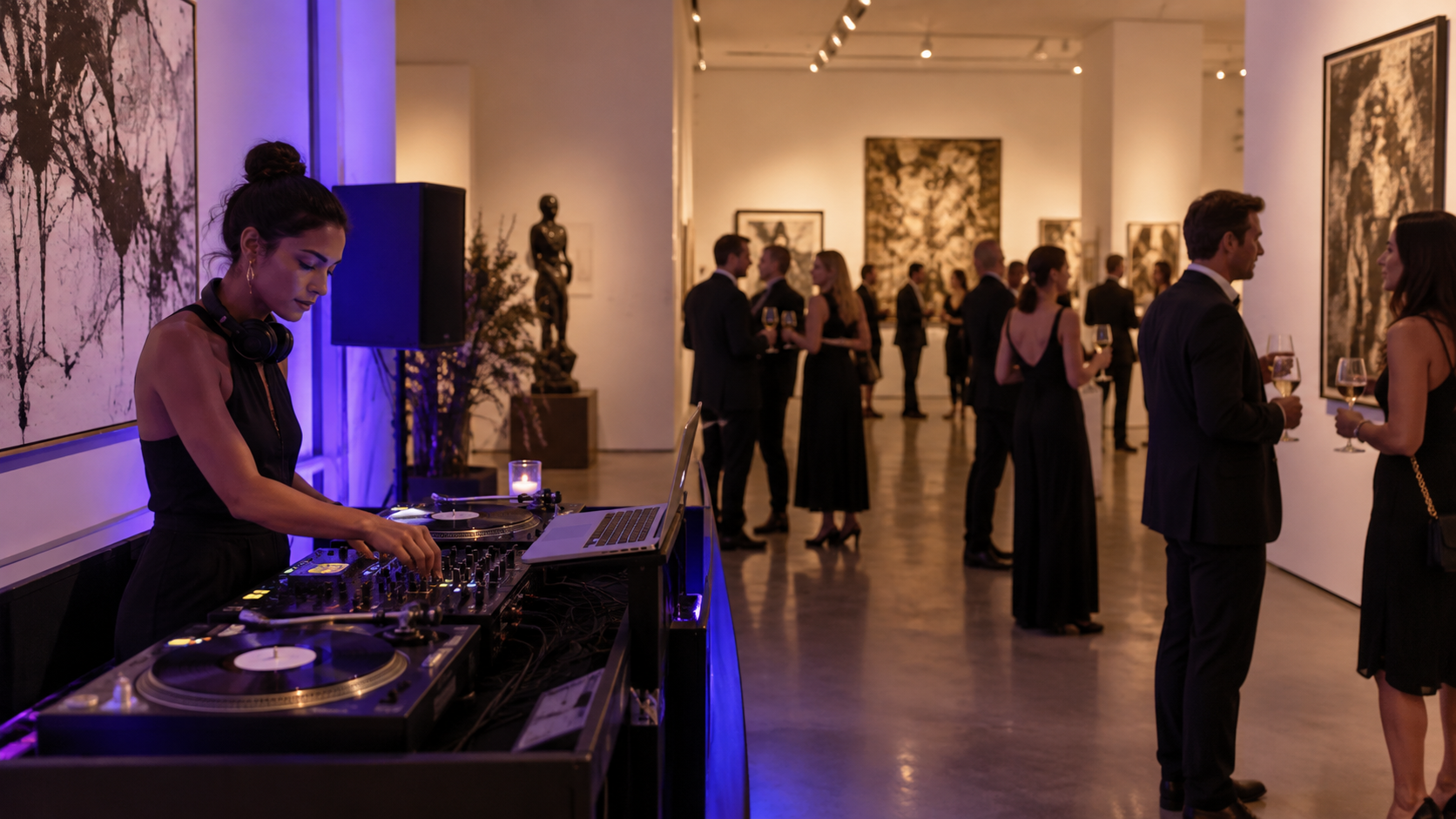
Most gallery directors I work with start with the same assumption: "We will just plug a phone into a speaker." That works until the cocktail crowd swells past sixty people, voices bounce off polished concrete floors, and the artist's remarks disappear into a wall of chatter. A professional DJ solves three problems at once: volume management, seamless transitions, and live mic support for toasts, remarks, and unveiling moments.
At a First Friday opening at The Filling Station in Opelika last spring, the gallery owner handed me a playlist of lo-fi jazz she had curated herself. Beautiful taste, but the tracks had wildly different mastering levels. One song whispered, the next blasted. I normalized the levels on the fly, kept the vibe she wanted, and handled two artist introductions through my wireless mic without a single pop or feedback squeal. That is the difference between a speaker and a sound professional.
Gallery Acoustics 101: Hard Surfaces, Fragile Art, and Conversation-Friendly Sound
Gallery spaces are acoustically unforgiving. Concrete floors, glass partitions, drywall, and high ceilings create reflection patterns that turn even moderate volume into a muddy wash. Here is how I approach sound in these rooms.
Speaker angle matters. I position tops at a 30-degree downward tilt, firing into the crowd mass rather than across the room. This keeps direct sound on guests and reduces wall reflection by roughly 40 percent compared to a flat horizontal aim.
Subwoofer placement is intentional. I decouple the sub from the floor using an isolation pad and keep output below 80 dB at the nearest artwork. Low-frequency vibration can loosen frames, rattle glass, and even trigger gallery alarm sensors. I have seen it happen at a Montgomery venue where a frameless canvas walked itself off a wire mount during a bass-heavy track.
dB ceiling for conversation. My target is 72 to 76 dB at ear level during cocktail hours and no higher than 82 dB during the after-party set. For reference, normal conversation sits around 65 dB. Staying in this range means guests can talk without leaning in, and the music still fills the room with energy.
| Factor | Bluetooth Speaker | Portable PA Rental | Professional DJ |
|---|---|---|---|
| Volume consistency | Uneven, track to track | Better, but no live mixing | Real-time level management |
| Mic support | None | Basic, often feedback-prone | Wireless with feedback suppression |
| Artwork vibration risk | Uncontrolled bass | Moderate, no isolation pad | Sub decoupled, dB monitored |
| Genre transitions | Gaps and silence | Playlist dependent | Beatmatched or crossfaded |
| Cost range | $0 (your own) | $150 to $300 rental | Professional investment |
| Live announcements | Shouting over music | Awkward pause-and-talk | Seamless ducking and mic cue |
| Backup plan if gear fails | None | None included | Redundant system on site |
Museum Event Timeline: DJ Cues from Setup to After-Party
Every gallery event I have worked follows a similar arc, but the details change based on the venue, the artist, and the crowd. Here is the timeline template I build from, with dB targets and MC cues at each phase.
| Time Block | Phase | dB Target | DJ/MC Cue | Music Style |
|---|---|---|---|---|
| 5:00 to 5:45 PM | Load-in and sound check | N/A | Test mic levels, walk room for dead spots | None |
| 6:00 to 7:00 PM | Cocktail reception | 72 to 74 dB | Ambient mix, no announcements | Jazz trio recordings, bossa nova, lo-fi |
| 7:00 to 7:15 PM | Artist remarks / unveiling | 60 dB (music bed) | Fade to underscore, hand mic to speaker | Soft piano or ambient pad |
| 7:15 to 7:30 PM | Toast and Q&A | 55 dB (music bed) | Monitor mic levels, cue applause track | Ambient only |
| 7:30 to 8:30 PM | Gallery browsing | 74 to 76 dB | Gradual energy lift, genre shift | Indie, soul, neo-R&B |
| 8:30 to 9:30 PM | After-party transition | 78 to 82 dB | Announce shift, open dance pocket | Upbeat funk, disco, curated house |
| 9:30 PM | Wrap and load-out | Fade to 65 dB | Thank-you announcement, final song | Classic closer |
The unveiling moment deserves special attention. I keep a soft ambient pad running underneath the speaker's remarks so the room never goes dead silent, which feels awkward in a large space. When the artist pulls the cover or the lights hit the piece, I have a swell cue ready, usually a slow orchestral build or a signature track the artist chose. That three-second transition from silence to sound is the emotional peak of the night, and it only works if the DJ is watching the room, not staring at a laptop.
Kevin books a limited number of weddings and events each month across Auburn and the surrounding area. Reach out today and let’s talk about your day.
Genre Selection for Gallery Events: Jazz Trio vs. Ambient Electronic vs. Curated Playlist vs. Live DJ
Choosing the right sound for a gallery opening depends on the art, the crowd, and the budget. I have worked events where a sparse ambient electronic set was perfect for a modern sculpture exhibit, and others where a warm jazz trio recording matched the watercolor landscapes on the walls. Here is how the options compare.
| Option | Pros | Cons | Best For |
|---|---|---|---|
| Jazz trio recording | Warm, classic, universally liked | Repetitive over 3 hours, no live energy | Traditional gallery, older demographic |
| Ambient electronic | Modern, unobtrusive, long sets available | Can feel cold, limited energy ceiling | Contemporary art, minimalist spaces |
| Curated playlist (no DJ) | Cheap, easy to set up | No live mixing, volume drift, no mic support | Small pop-up shows under 40 guests |
| Live DJ (curated set) | Real-time mixing, mic support, energy control | Higher investment, requires power and space | Any event over 50 guests, fundraiser, unveiling |
For most Auburn and Opelika gallery events, I blend all three approaches. I open with jazz trio recordings during cocktails, shift to ambient electronic during remarks, and transition to a curated live mix for the browsing and after-party phases. This arc matches the energy of the room without ever feeling forced.
Protecting the Art: Vibration, Heat, and Cable Safety
This section is one that separates a gallery-experienced DJ from a general event DJ. Museums and galleries have rules, and ignoring them means you do not get invited back.
Vibration control. I already covered sub isolation, but it goes further. I avoid placing any speaker within six feet of hanging art. If the room layout forces proximity, I angle the driver away from the piece and drop output by 6 dB on that side. At the Jule Collins Smith Museum, the staff required a pre-event sound check with a gallery technician holding a vibration sensor near sensitive pieces. We passed on the first try because I had already set conservative limits.
Heat from lighting. Traditional PAR cans and halogen fixtures throw heat. I use LED uplights exclusively, which run cool to the touch and can be placed within inches of a wall without risking paint or canvas. If the venue has its own gallery lighting, I coordinate with their electrician to ensure my fixtures do not overload a shared circuit.
Cable management. Gallery floors are usually polished concrete or hardwood. Guests in heels and dress shoes are one untaped cable away from a liability claim. I run all cables along walls, under carpet runners, or through cable ramps rated for foot traffic. Every cable is taped flat with gaffer tape, never duct tape, which leaves residue on finished floors.
Working with Gallery Staff and Curators
I always request a walkthrough at least one week before the event. During that visit, I note power outlet locations, load-in paths, restricted zones, and any artwork that requires extra clearance. I ask three questions every time:
- Are there any pieces that are vibration-sensitive or loan pieces with insurance restrictions?
- Where are the circuit breaker panels, and which circuits can I use without tripping shared loads?
- What is the hard stop time, and are there noise restrictions from neighboring tenants?
This walkthrough saves me from surprises on event night. At a pop-up gallery in downtown Opelika, I discovered during the walkthrough that the building shared a wall with a law office that closed at 6 PM. We adjusted the after-party timeline to keep bass levels neighborly until the office staff cleared out, then opened up the low end for the final hour.
5-Step Booking Checklist for Your Gallery or Museum Event
Step 1 (8 weeks out): Confirm event date, venue, and expected guest count. Reach out to me at (334) 521-2835 or [email protected] to hold the date.
Step 2 (6 weeks out): Schedule a venue walkthrough. I will assess acoustics, power, load-in logistics, and artwork proximity.
Step 3 (4 weeks out): Finalize the event timeline, including artist remarks, unveiling cues, and any toast or Q&A segments. Share any must-play or do-not-play tracks.
Step 4 (2 weeks out): Confirm power access, load-in time, and any venue-specific rules (dB limits, cable requirements, restricted zones). I will send a detailed setup diagram.
Step 5 (day of): I arrive 90 minutes before doors open for load-in, sound check, and a final walkthrough with gallery staff. After the event, I break down quietly and leave no trace.
Kevin books a limited number of weddings and events each month across Auburn and the surrounding area. Reach out today and let’s talk about your day.
Cross-Selling: Photo Booth for Gallery Events
A photo booth at an art opening is not just entertainment, it is a branding opportunity. I set up our photo booth with a custom digital frame that matches the exhibition theme. Guests step in, snap a photo with accessories that echo the art style (think oversized vintage frames, artist berets, paint palette cutouts), and walk away with a branded print.
At a recent Auburn Arts Association event, we printed 260 strips in three hours. Every print had the gallery logo and exhibition title, which meant 260 branded keepsakes walked out the door and onto refrigerators and Instagram stories across Lee County. Our AI photo booth option also lets guests apply art-style filters, turning their portrait into an impressionist or pop-art version of themselves.
Check out our full photo booth lineup for options that fit gallery spaces without cluttering the floor plan.
Final Thoughts
Gallery and museum events demand a DJ who understands restraint as much as energy. The best compliment I have ever received after a gallery opening was from a curator who said, "I forgot you were here, and that is exactly what I wanted." That is the goal: sound that serves the art, supports the artist, and lets the guests feel something without ever competing for attention.
If you are planning a gallery opening, exhibition launch, museum fundraiser, or art walk event in Auburn, Opelika, or anywhere in East Alabama, I would love to talk through your vision. Call or text (334) 521-2835 or email [email protected]. You can also explore our full corporate event services or browse the blog for more guides like this one.
Frequently Asked Questions
How loud should music be at a gallery opening?
I target 72 to 76 dB during cocktails and no higher than 82 dB during the after-party. This keeps conversations comfortable while still filling the room with energy.
Can a DJ setup damage artwork in a museum?
Uncontrolled bass can vibrate frames and trigger alarms. I decouple subwoofers with isolation pads, maintain a six-foot clearance from hanging art, and use LED lights that produce no heat.
What kind of music works best at an art exhibition?
I blend jazz trio recordings for cocktails, ambient electronic for remarks, and curated live mixes for browsing and after-party phases. The genre arc matches the room energy.
Do I need a mic for artist remarks at a gallery event?
Yes. A wireless mic with feedback suppression ensures the artist is heard clearly without shouting. I fade music to an underscore bed so remarks carry naturally.
How far in advance should I book a DJ for a museum event?
Eight weeks is ideal. This gives time for a venue walkthrough, acoustic assessment, and timeline planning with gallery staff and curators.
Can you set up a photo booth inside a gallery?
Absolutely. I use compact setups that fit gallery floor plans. Art-themed accessories and branded prints turn every guest photo into a marketing piece for the exhibition.
What is a venue walkthrough and why does it matter?
I visit the gallery one week before to check power outlets, load-in paths, restricted zones, and vibration-sensitive pieces. This prevents surprises on event night.
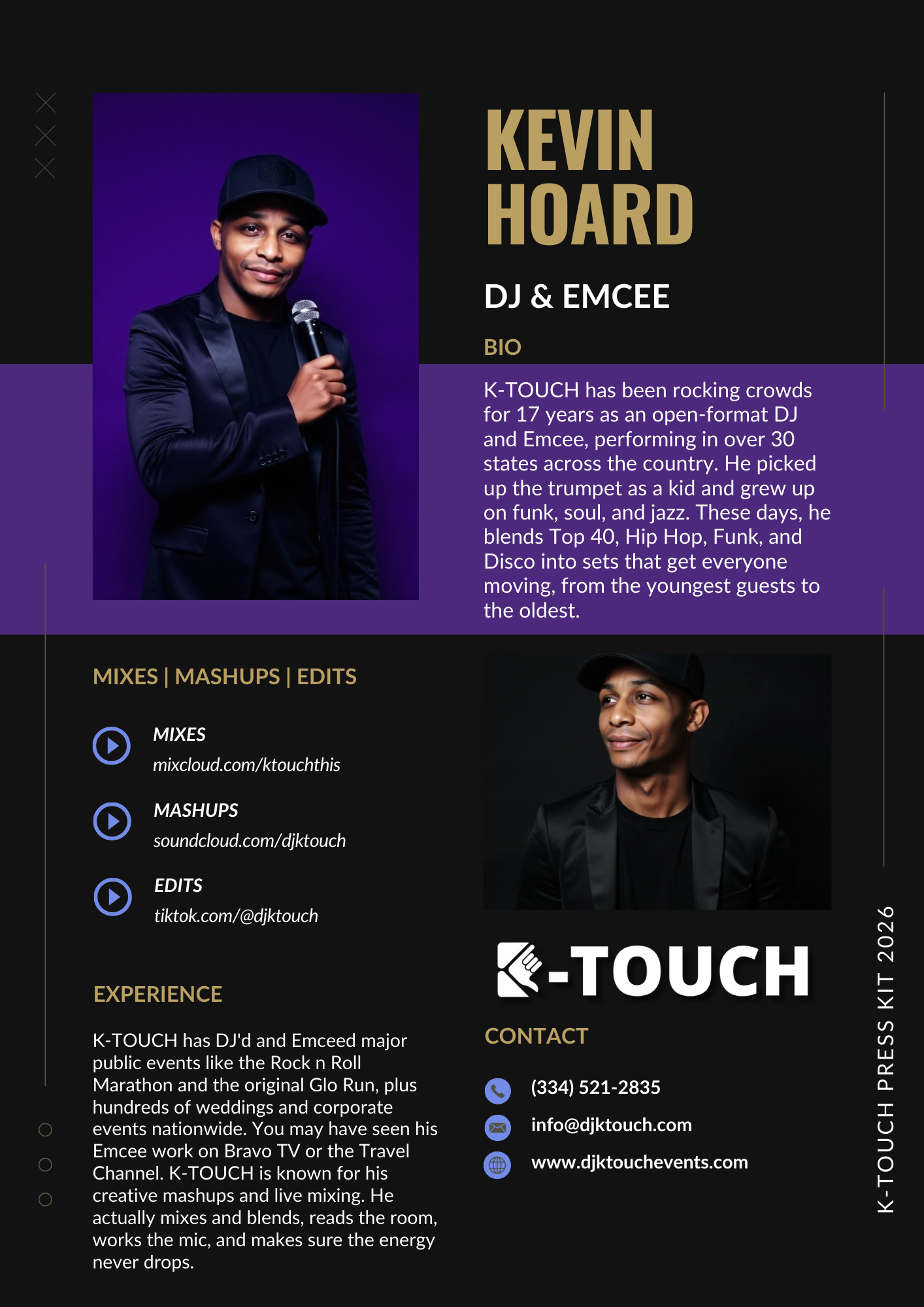
About the Author
Kevin Hoard (DJ K-TOUCH)
Kevin is the lead DJ and MC behind DJ K-TOUCH Events & Services. He has been DJing Auburn area weddings since 2012 and started DKES in 2019. He has read hundreds of dance floors across Auburn, Opelika, Montgomery, and beyond, and he writes these guides to help couples plan events that actually feel like them.
Let’s Talk About Your Event
Whether it’s a wedding, a school dance, or a company party, Kevin will help you build a night your guests remember. Dates around Auburn book up fast, so reach out early.