Backyard Speaker Setup Guide: How to Get Perfect Sound at Your Auburn Outdoor Party
Key Takeaways
- •Speaker placement and angling matter more than raw wattage for even backyard sound coverage.
- •Follow the 5-step sound check before guests arrive to prevent dead zones and neighbor complaints.
- •Auburn's noise ordinance kicks in at 10 PM, so drop volume and shift to mellow tracks after dark.
- •Most Auburn backyard parties of 30 to 80 guests need two powered 12-inch tops and one 18-inch sub.
- •A quick neighbor heads-up on event day has prevented every single noise complaint at my outdoor events.
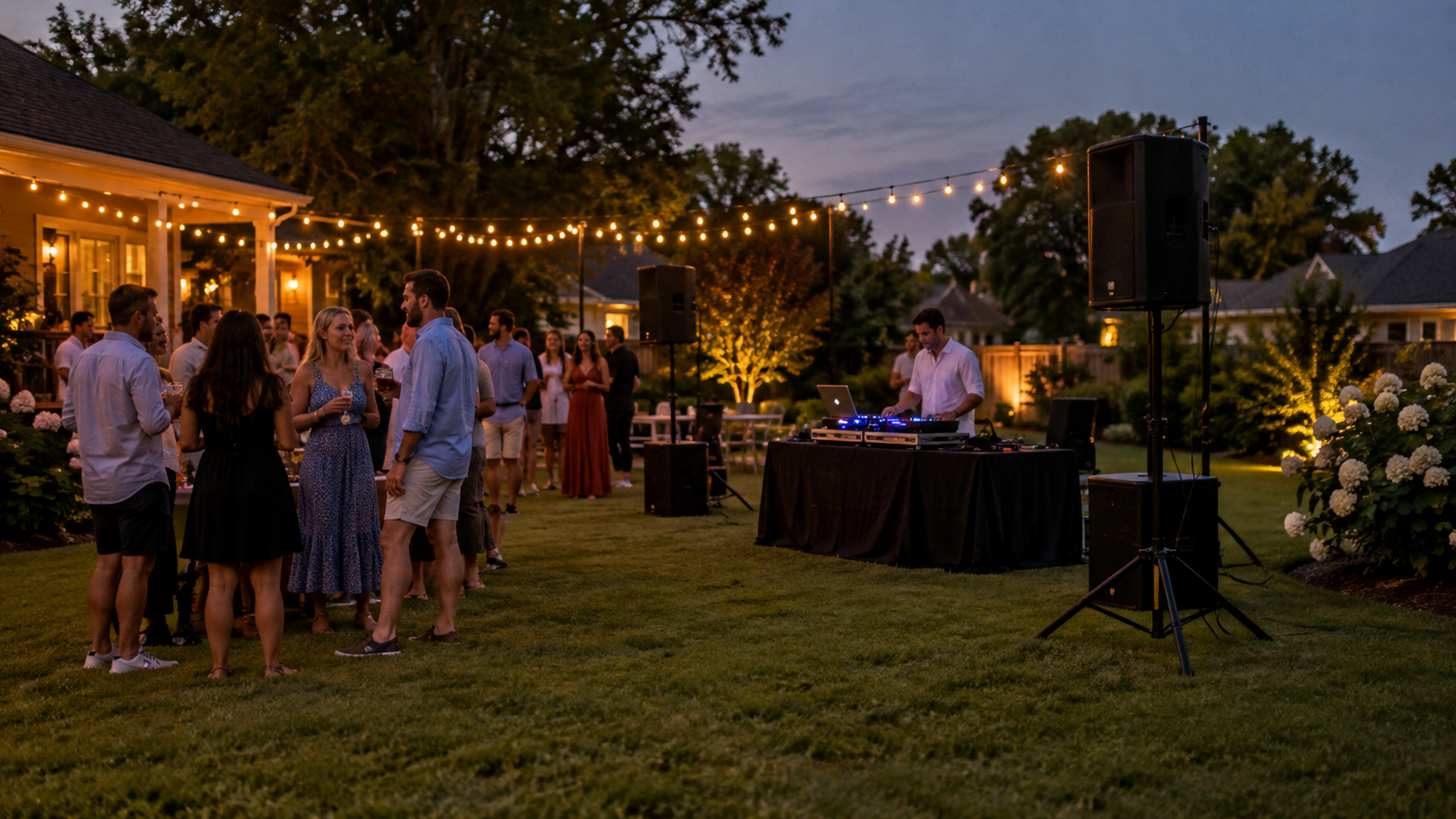
Have you ever watched a perfectly good backyard party fall apart because nobody could hear the music past the cooler table? I have. Last summer I set up for a 40th birthday at a house in Moores Mill, and the host had already tried running two Bluetooth speakers from the kitchen window. The guests near the patio were getting blasted while everyone around the firepit thought the music was off. Fifteen minutes of repositioning my JBL PRXs on tripod stands and dialing in zones fixed the whole yard.
That night stuck with me because it is the exact problem I see at almost every backyard event in Auburn and Opelika. Great food, great people, terrible sound coverage. This guide breaks down exactly how to place speakers, choose the right wattage, handle noise ordinances, and keep the party rolling without a single complaint from the neighbors.
If you want to skip straight to a free sound consultation, call or text me at (334) 521-2835 or email [email protected].
Why Speaker Placement Matters More Than Speaker Price
Most people shop watts first and placement second. That is backwards. A $2,000 PA pointed at your fence does less for your guests than a $600 pair of powered tops angled correctly across the listening area. Sound dissipates roughly 6 dB every time you double the distance from the source, so a speaker 40 feet from half your crowd is barely background noise while the folks up front are wincing.
The goal is even coverage at a comfortable volume everywhere guests will stand, sit, or dance. That means thinking about speaker height, angle, and separation before you ever touch the volume knob.
How Much Wattage Do You Actually Need?
Yard size, guest count, and whether you are doing speeches or just music all change the math. Here is the table I hand every private-party client before their event:
| Yard Size (approx.) | Guest Count | Recommended Total Watts (RMS) | Speaker Config | Notes |
|---|---|---|---|---|
| Small patio, under 1,500 sq ft | 15 to 30 | 400 to 600 W | 2 powered tops on stands | Angle inward at 45 degrees |
| Medium yard, 1,500 to 3,000 sq ft | 30 to 75 | 800 to 1,200 W | 2 tops + 1 sub | Sub near DJ table, tops flanking dance zone |
| Large yard, 3,000 to 5,000 sq ft | 75 to 150 | 1,500 to 2,500 W | 4 tops (2 pairs) + 1 to 2 subs | Delay pair halfway back at lower volume |
| Estate or field, 5,000+ sq ft | 150+ | 3,000+ W | Distributed system, delay fills | Professional sound tech strongly recommended |
If you are doing toasts or a ceremony reading, add a wireless handheld mic and a small monitor wedge near the speaker so they can hear themselves. I bring both to every private event by default.
The 5-Step Backyard Sound Check
Follow this before guests arrive and you will avoid 90 percent of outdoor sound problems.
- Walk the boundary. Stand at every spot guests will gather, including the drink station, food table, seating, and dance area. Mark the farthest point from your speaker location.
- Set speaker height. Tops should sit at 5.5 to 6 feet on tripod stands so the drivers fire above head level. This pushes sound over the crowd instead of hitting the first row in the chest.
- Angle inward. Tilt each speaker 30 to 45 degrees toward the center of the listening area. You want the coverage patterns to overlap slightly in the middle of the yard, not spray outward toward the neighbors.
- Play a reference track and walk. I use Stevie Wonder's "Signed, Sealed, Delivered" because it has vocal clarity, bass punch, and midrange detail. Walk to every guest zone and adjust EQ. Cut low-mids (200 to 400 Hz) if the yard sounds boomy. That mud buildup is common when speakers reflect off a back wall or wooden deck.
- Check the property line. Stand at the fence nearest your closest neighbor. If you can clearly make out lyrics at that point, lower overall volume 2 to 3 dB and rely on the sub for perceived energy. Bass is felt more than heard at a distance, so shifting the balance keeps the dance floor thumping without sending treble across the street.
Kevin books a limited number of weddings and events each month across Auburn and the surrounding area. Reach out today and let’s talk about your day.
Indoor vs. Outdoor Sound: What Changes and Why
People assume outdoor sound is just louder. It is actually harder because you lose every acoustic advantage a room gives you. Walls, ceiling, and floor all reflect sound back toward listeners. Outdoors, that energy escapes in every direction.
| Factor | Indoor (ballroom or clubhouse) | Outdoor (backyard or patio) |
|---|---|---|
| Natural reflections | Walls add 3 to 6 dB of perceived volume | No reflections, sound escapes upward and outward |
| Bass response | Room reinforcement fills in low end | Bass drops off fast, sub placement is critical |
| Wind interference | None | Wind above 10 mph can push treble off axis |
| Noise bleed | Contained by walls | Travels to neighbors, requires careful aiming |
| Speaker count needed | Often 2 tops suffice for 100 guests | May need 4 tops + delay fill for 100 guests outdoors |
| EQ adjustments | Moderate, room dependent | Significant, cut low-mids, boost highs slightly |
| Cable runs | Short, predictable | Long, need weatherproof connectors and cable ramps |
The biggest mistake I see at Auburn clubhouse parties versus backyard parties is using the same speaker setup for both. A pair of QSC K12.2s that filled the Yarbrough Farms clubhouse last month needed a second pair as delay speakers when we moved the same event outdoors this past spring.
Auburn and Opelika Noise Ordinances: What You Need to Know
The City of Auburn noise ordinance (Chapter 14, Article II) defines unreasonable noise as sound that is "plainly audible" at a distance of 50 feet from the property where it originates during nighttime hours (10 PM to 7 AM). Opelika follows a similar standard. Lee County unincorporated areas defer to Alabama state nuisance statutes, which are less specific but still enforceable if a neighbor files a complaint.
Here is what I recommend to every client:
- Keep your event volume at conversational level (around 75 to 80 dB at the property line) before 10 PM.
- After 10 PM, drop overall volume by 5 to 8 dB and shift music style from high-energy dance tracks to lounge and R&B. Songs like Sade's "Smooth Operator" or Frank Ocean's "Thinkin Bout You" keep the mood alive without the kick drum carrying three houses down.
- If your HOA has its own rules (Asheton Lakes, Farmville, and several Opelika subdivisions do), check the covenants. Some cap amplified music at 9 PM.
- Let your nearest neighbors know in advance. A quick knock on the door Saturday morning with an end time goes a long way. I have never had a noise complaint at an event where the host gave that heads-up.
Speaker Placement Diagram: Where to Aim by Yard Layout
Every yard is different, but most Auburn and Opelika backyards fall into one of three shapes. Here is how I set up each one:
| Yard Layout | Speaker Positions | Sub Placement | Delay Speakers? | Key Tip |
|---|---|---|---|---|
| Rectangular (most common) | 2 tops at one short end, angled 30 degrees inward | Against house wall near DJ table | Yes, if yard exceeds 60 feet deep | Aim tops toward the far third of the yard |
| L-shaped (patio wraps around house) | 1 top on each wing of the L, aimed toward the center | Center of the L bend | Rarely needed | Use the house corner as a natural reflector |
| Wide and shallow (deck facing open field) | 2 tops spread wide, 15 to 20 feet apart on stands | Center, 3 to 5 feet in front of DJ table | No, but raise speaker height to 7 feet | Widen the angle to 50 to 60 degrees for horizontal coverage |
For estate-sized properties or open fields (think Pebble Hill or a farm wedding reception moved outside), I switch to a distributed system with four to six tops on delay timing so guests 100 feet away hear audio in sync with the front row.
Bluetooth Speaker vs. Professional DJ Sound: An Honest Comparison
I am not here to trash Bluetooth speakers. They are perfect for a small porch hangout with six friends. But once your guest list crosses 25 or you want dancing, the gap gets wide fast.
| Feature | Bluetooth Speaker (JBL Charge, Bose, etc.) | Professional DJ PA (powered tops + sub) |
|---|---|---|
| Max clean volume | 80 to 85 dB at 3 feet | 120+ dB at 3 feet (used at 90 to 95 dB for parties) |
| Coverage area | 10 to 15 foot radius | 40 to 80+ foot throw per speaker |
| Bass response | Thin below 60 Hz | Full sub-bass down to 35 Hz |
| Mic input for toasts | Usually none | Multiple XLR and 1/4 inch inputs |
| Crossfade and mixing | Phone app only | Full DJ controller with live EQ |
| Wind resistance | Easily overwhelmed above 8 mph | Directional horns cut through moderate wind |
| Setup time | 2 minutes | 30 to 45 minutes (handled by DJ) |
| Cost to own | $150 to $400 | $2,000 to $6,000+ for quality rig |
| Cost to hire a DJ with full PA | N/A | Call (334) 521-2835 for a custom quote |
The sweet spot for most Auburn backyard parties of 30 to 80 guests is a pair of powered 12-inch tops on stands with a single 18-inch sub. That combo handles music, speeches, and even a small dance area without breaking a sweat.
Kevin books a limited number of weddings and events each month across Auburn and the surrounding area. Reach out today and let’s talk about your day.
Cables, Power, and the Stuff Nobody Thinks About Until It Rains
Outdoor events need longer cable runs than indoor ones. A typical backyard setup for me uses 75 to 100 feet of speaker cable and two 50-foot extension cords running to separate circuits. If you plug everything into one outlet, you will trip a breaker mid-song, and I promise it will happen during the best man's toast.
Here are the power basics:
- Each powered speaker draws roughly 5 to 8 amps. A standard 15-amp household circuit handles two speakers safely.
- The sub draws 8 to 12 amps on peaks. Give it its own circuit.
- Use outdoor-rated extension cords (12 AWG minimum for runs over 25 feet). Indoor cords can overheat.
- Tape down every cable run with gaffer tape or use cable ramps at walkways. Someone tripping over a speaker cable at 9 PM is not the kind of party moment you want.
- If rain is possible, have plastic bins ready to cover the mixer and any electronics. My gear bags include fitted rain covers for every speaker and the DJ booth.
Book a Free Backyard Sound Consultation
Every yard is different, and a five-minute phone call can save you hours of guesswork. I will ask about your yard dimensions, guest count, whether you need a mic for toasts, and what vibe you are going for. From there I will recommend the right speaker package and send you a placement sketch before the event.
Call or text me at (334) 521-2835, email [email protected], or check out our private party DJ services and event rental options for packages that include delivery, setup, and breakdown.
Frequently Asked Questions
How many speakers do I need for a backyard party of 50 guests?
Two powered 12-inch tops on stands plus one 18-inch sub will cover a medium yard of 1,500 to 3,000 square feet for 50 guests with clean, even sound.
What time does the Auburn noise ordinance start?
Auburn's ordinance defines nighttime as 10 PM to 7 AM. Sound that is plainly audible 50 feet from your property during those hours can draw a complaint.
Can I use Bluetooth speakers instead of hiring a DJ?
Bluetooth speakers work for small gatherings under 20 people. Above 25 guests or if you want dancing, a professional PA system provides the volume, bass, and mic inputs you need.
How high should I place outdoor speakers?
Set speaker tops at 5.5 to 6 feet on tripod stands so drivers fire above head level. This pushes sound over the crowd and reduces hot spots near the front.
Do I need a separate circuit for my subwoofer?
Yes. A powered sub draws 8 to 12 amps on peaks. Sharing a 15-amp circuit with other speakers risks tripping the breaker mid-event.
How do I reduce bass bleed to my neighbors?
Aim the sub toward your house wall so it reflects inward. Lower overall volume 2 to 3 dB and let the sub carry perceived energy, since bass is felt more than heard at a distance.
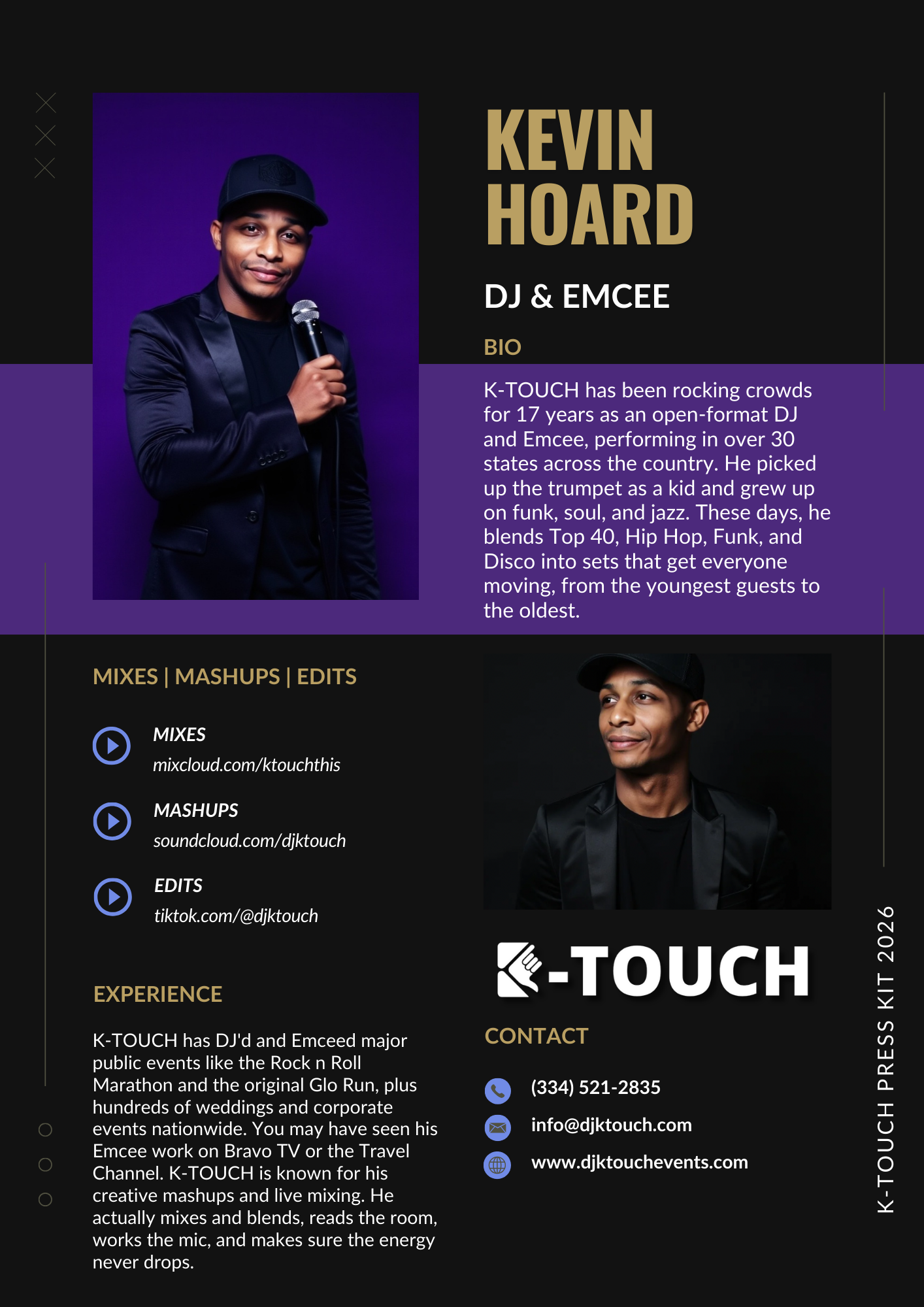
About the Author
Kevin Hoard (DJ K-TOUCH)
Kevin is the lead DJ and MC behind DJ K-TOUCH Events & Services. He has been DJing Auburn area weddings since 2012 and started DKES in 2019. He has read hundreds of dance floors across Auburn, Opelika, Montgomery, and beyond, and he writes these guides to help couples plan events that actually feel like them.
Let’s Talk About Your Event
Whether it’s a wedding, a school dance, or a company party, Kevin will help you build a night your guests remember. Dates around Auburn book up fast, so reach out early.